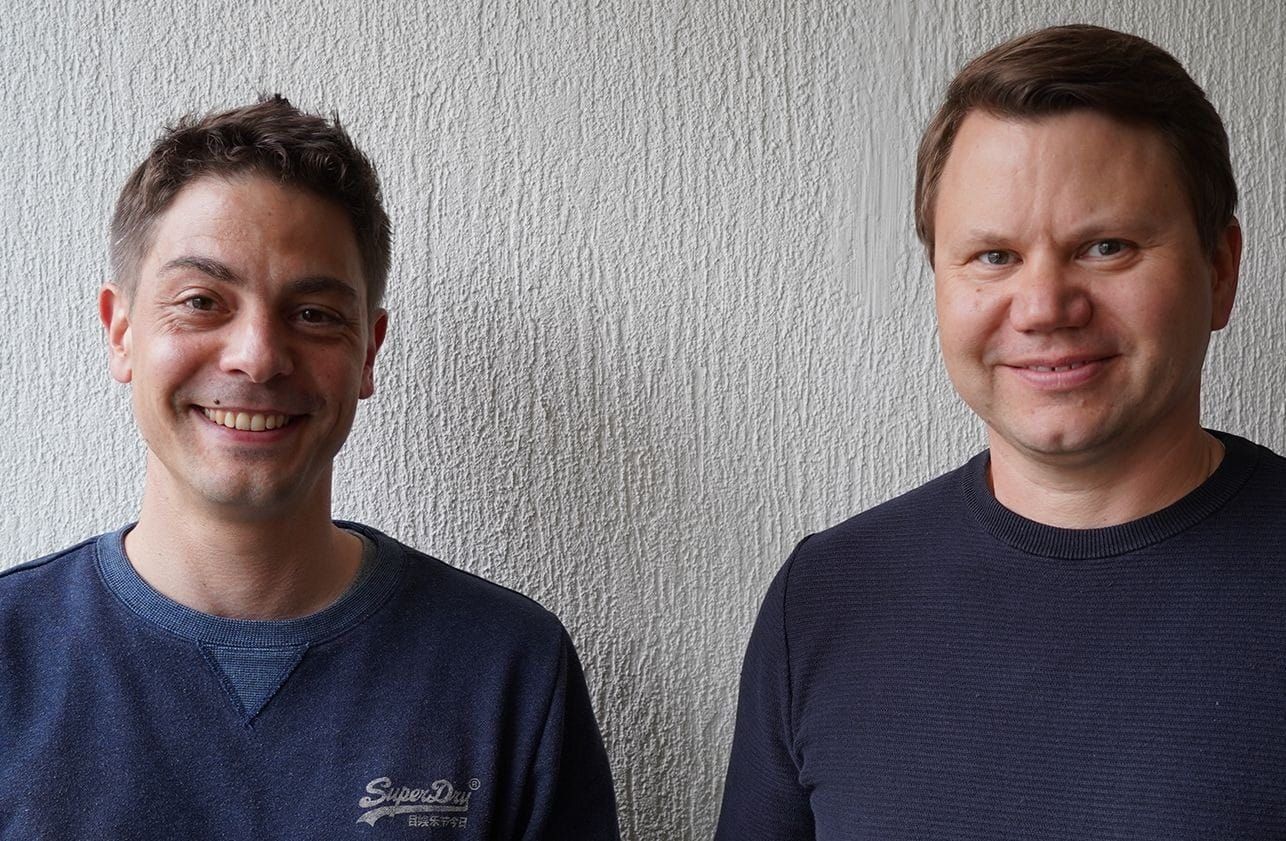
Two founders discovered a problem that had been largely overlooked in logistics for decades. “The longer I work in logistics, the less sense it makes to me that anything ever arrives at all.” When Lenny Göltl says this, he laughs himself.
From the outside, logistics looks like trucks, ships and containers. From the inside, it is mostly people keeping everything moving: drivers, dispatchers and freight planners make thousands of decisions every day.
Bernhard Elkuch describes logistics as “the main artery of the global economy.” He comes from a Liechtenstein freight forwarding family. “As long as I can remember, there have been trucks in front of our house.” He trained as a truck mechanic, became a freight forwarding specialist and later developed transport management systems.
Lenny’s path took him from science to Kühne + Nagel and later to Flexport, where he worked with real-time data and digital flows of goods. “On the one hand, logistics is very tangible. On the other, the whole thing is even more complicated than physics,” he says. The two came to the same realization: logistics works remarkably well. But not because of its systems, rather, despite them. “Ultimately, master data dictates how well everything works,” says Lenny.
The Real Operating System
When organizing a transport, you rarely send just an address. There are access roads, gate numbers, time windows, contact people and security requirements.
“Only the drivers know all of that,” says Bernhard. “And an entire generation of drivers will soon be retiring.”
The two founders asked themselves a simple question: Where is all this knowledge actually stored? The answer? In an Excel spreadsheet. In an email. In a dispatcher’s head. Or nowhere at all.
“We’ve managed to make it work so far. Why should I change anything?” Bernhard still hears this regularly.
But logistics is changing. Companies are investing in route planning, real-time information and increasingly automated processes. All of these technologies depend on one thing: reliable data.
The Overlooked Problem
When Lenny and Bernhard first met, there was no business plan.
“We got to know each other a little and realized that the chemistry was right,” says Bernhard.
What connected them was an observation. Most software focuses on the transport itself. Very little focuses on the place where that transport starts or ends. “We are building the digital twin of a location,” says Bernhard. Whenever new information enters existing systems, new spellings, new addresses and new duplicates are created. The systems simply carry these inaccuracies forward.
"Without the underlying data, even the best software is of no use.”
Bernhard Elkuch
“We’re solving a very specific problem that somehow nobody had really on their radar,” says Bernhard.
This thinking led to Match & Clean. The software identifies the same physical location behind different versions of an address, something people understand immediately, but many systems do not.
“In logistics, you quickly realize: if the address is wrong, you’re going to fall flat on your face,” says Bernhard.
For him, however, this is only the beginning.
The Shared Platform
Match & Clean answered one question, but at the same time created another. Once you know which location a record actually refers to, who takes care of all the knowledge associated with that location? Who keeps opening hours up to date? And who decides which information can be shared?
This led to the idea of a platform. Not for addresses, but for shared location knowledge.
Lenny believes that collaborative data maintenance is still neglected in logistics: “Everyone wants to play on the grass, but nobody wants to mow it.”
With Siemens Energy, LogBook gained its first major industrial customer early on. The idea was to help shippers manage their locations more accurately and provide freight forwarders with better information.
“It’s the people who still talk to each other and make sure that everything works.”
Lenny Göltl
But they soon realized that many shippers did not see the problem as their own. “It’s a nice system, but the freight forwarder will figure it out. That’s what I pay them for,” Lenny heard repeatedly.
Bernhard had the same experience. Many large companies simply referred to their logistics providers. “They know everything.”
For most shippers, location data was not considered part of their core business. As long as the goods left the facility, the job was done.
For the founders, this became a turning point. They realized that it was not the shippers who were ultimately living with poor location data. It was the freight forwarders, dispatchers and drivers.
LogBook therefore shifted its focus decisively towards logistics service providers.
Towards the Freight Forwarders
Today, logistics service providers such as Finsterwalder and Nox work with LogBook. Match & Clean, document parsing and the platform for location knowledge have become part of their everyday operations.
For Bernhard, this is only the first step.
“In the end, it’s all about data. Without the underlying data, even the best software is of no use.”
For Lenny, logistics continues to work largely because of its people.
“It’s the people who still talk to each other and make sure that everything works.”
LogBook is making that knowledge visible and usable in a systematic way for the first time. The data whisperers are bringing to light what the industry has stored for decades, in the minds of its drivers and dispatchers.