Why updates in one system don’t propagate correctly to others
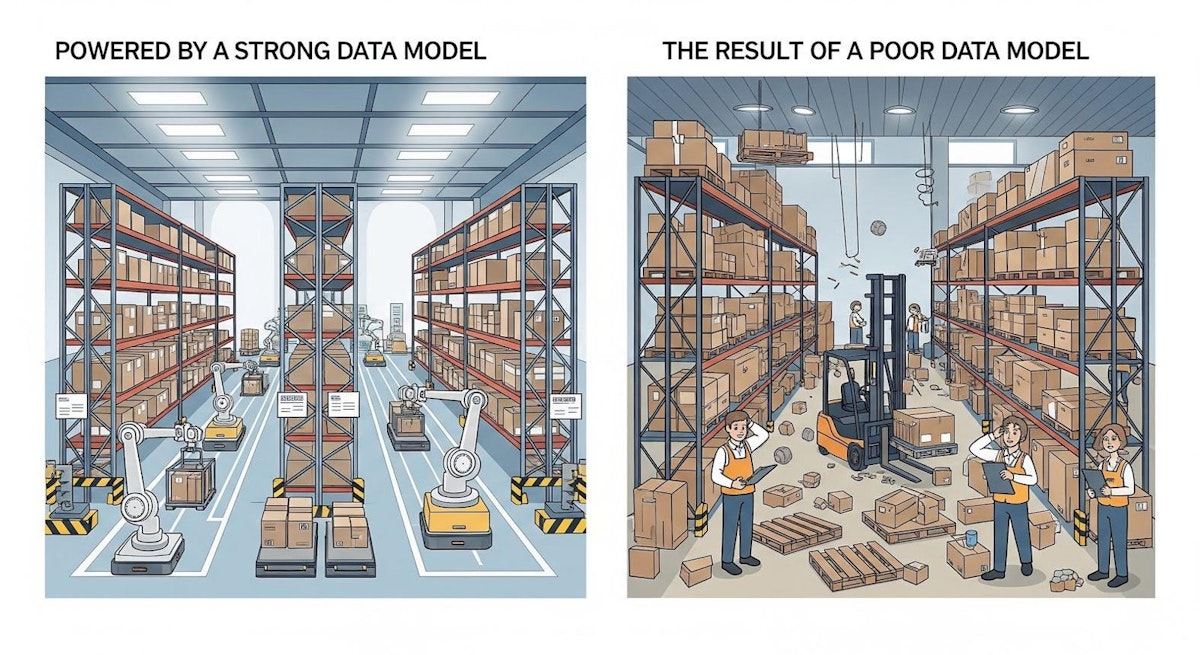
In a modern supply chain, location data is constantly changing. A customer moves to a new address, a warehouse changes its entrance, a supplier updates its delivery instructions, or a distribution center begins operating from a different site. These changes may appear simple, but keeping them consistent across the systems that depend on them can be surprisingly difficult.
The problem is rarely that a business does not know an update has happened. The bigger challenge is making sure that the update reaches every system, application, partner, and process that uses the location. An address can be corrected in the ERP while an outdated version remains in the WMS, TMS, carrier platform, or customer database. Each individual system may continue to function, but the supply chain as a whole is now working with different versions of the same reality.
A Location Change Does Not Happen in Only One Place
When a location changes, the first update usually happens where the change is reported or discovered. For example, a customer may notify the sales team that they have moved, an employee may update a supplier record, or a logistics team may discover that a delivery entrance has changed.
That update then needs to travel through the wider data ecosystem. If the location is used by an ERP, WMS, TMS, transport planning platform, carrier, customer portal, and reporting system, each of those environments may depend on the information in a different way. The physical change may happen once, but the digital change has to be reflected many times.
This is where seemingly small updates can become a continuity problem. The business may have one current address, but several systems may still contain older versions of it.
Why Data Updates Get Stuck
One of the simplest reasons updates fail to propagate is that systems are not always connected in the way businesses assume. An organization may have integrations between its major platforms, but that does not necessarily mean every relevant location attribute is synchronized automatically.
Some integrations only transfer selected fields. Others may run on scheduled batches rather than in real time. A system may receive a customer update but not overwrite an existing value because of validation rules or data ownership policies. In other cases, the receiving system may have a different structure and may not know how to interpret the incoming information.
The result is that an update can successfully leave one system without successfully becoming the new version of the location everywhere else.
Different Systems Have Different Rules
Even when systems are connected, they do not necessarily treat location data in the same way. An ERP might consider the official street address the most important information, while a TMS may rely more heavily on coordinates, access points, or transport-specific instructions. A WMS may store dock information that does not exist in the ERP at all.
This creates an important distinction between transmitting an update and applying an update correctly. A message can be sent from one system to another, but if the receiving system interprets, stores, or maps the information differently, the result may still be inconsistent.
For example, changing a street address may be enough for a customer master record, but transportation planning may also need a new geocode or geofence. If only the street address changes, the TMS may continue routing vehicles based on the old coordinates. The data has technically been updated, but the operational location has not.
Data Ownership Can Create Another Barrier
Another common challenge is uncertainty over which system is responsible for maintaining the “correct” version of a location. In complex organizations, different teams may manage different parts of the same record.
The commercial team may maintain customer information in the CRM or ERP. Operations may manage delivery details in the TMS. Warehouse teams may maintain site-specific information in the WMS. A carrier may have its own operational version of the location. When responsibility is distributed this way, an update made by one team does not automatically become authoritative for everyone else.
Without clear ownership and rules for synchronization, systems can gradually develop their own versions of the truth. Over time, nobody may be entirely sure which record is current.
Manual Corrections Create More Versions
When an automated update does not arrive, operational teams often compensate manually. A planner changes an address directly in the TMS. A warehouse employee corrects a delivery point in the WMS. A carrier updates its own database after a driver reports an issue.
These manual corrections can solve the immediate problem, but they can also create a new one. The local system is now more accurate, while the original source may still contain the outdated information. The next time data is synchronized, the old value could potentially overwrite the correction or create yet another discrepancy.
This is how a single location can gradually accumulate multiple versions across the supply chain. Each correction may have made sense at the time, but without a coordinated process, the overall data becomes increasingly fragmented.
When an Update Changes More Than an Address
Location updates are also more complex than simply replacing one address with another. A physical location can change its name, entrance, coordinates, operating hours, loading restrictions, contact information, or delivery instructions without actually changing its physical identity.
Consider a warehouse that remains at the same site but changes its primary truck entrance. The postal address is still correct, but the operational information needed by a carrier has changed. If only the address is synchronized, the systems that rely on access information may continue using outdated instructions.
This is why location data needs to be treated as a connected set of attributes rather than a collection of independent fields. An update to one piece of information can affect routing, geofencing, planning, delivery execution, and customer communication.
The Cost of Working With Different Versions
When systems disagree about a location, the impact is often difficult to trace back to the original data problem. A planner may see an outdated address and assign an inefficient route. A driver may arrive at the wrong entrance. A warehouse may prepare an order based on incorrect delivery instructions. Customer service may see information that no longer matches what the carrier has.
Individually, these incidents may appear unrelated. Together, they are symptoms of the same underlying issue: the location has lost continuity as it moved between systems.
The cost can include additional mileage, failed deliveries, manual work, delays, customer complaints, and unnecessary operational intervention. More importantly, teams may spend time correcting the same location repeatedly because the underlying inconsistency has never been resolved.
Integration Moves Data, but Does Not Guarantee Continuity
It is tempting to assume that better integrations will automatically solve the problem. Integration is certainly necessary, but it is not sufficient.
An integration answers the question: Can information move from one system to another? Data continuity asks a different question: Does the receiving system still understand this as the same location, with the correct and current information?
That distinction is critical. A perfectly functioning interface can transfer outdated data. It can transfer only part of a location record. It can create a duplicate instead of updating an existing location. Or it can move information into a system where it has a different meaning or structure.
Reliable continuity therefore requires more than connectivity. It requires consistent location identities, clear ownership, matching logic, validation, synchronization rules, and visibility into how location data changes across the network.
A Change Should Have a Traceable Journey
A reliable location data environment should make it possible to understand what changed, where it changed, and how that change propagated through the supply chain.
If a customer changes an address, the business should be able to identify the affected location and understand which systems and partners depend on it. If the location is updated in one system but not another, that discrepancy should be detectable rather than discovered only after a failed delivery.
This creates an important principle for Logistics Continuity: a location update should have a traceable journey of its own. The goal is not simply to synchronize databases, but to maintain the connection between the physical location and all of its digital representations.
Keeping One Location in Sync Across the Network
The foundation for reliable updates is a consistent location identity. When systems can recognize that different records represent the same physical place, changes can be managed at the level of the location rather than treated as unrelated edits to individual database entries.
This makes it possible to distinguish between a genuinely new location and an updated version of an existing one. It also allows businesses to identify where outdated records still exist, determine which systems need to be updated, and prevent local corrections from creating further fragmentation.
The objective is not necessarily to force every system to store identical information. Different applications will continue to need different attributes and structures. What matters is that those differences remain connected to one trusted underlying location.
Why This Matters as Supply Chains Become More Connected
The challenge of propagating updates becomes more important as supply chains involve more systems, partners, and automated processes. A location change that once affected one database may now influence transportation planning, warehouse operations, carrier execution, customer notifications, routing engines, analytics, and AI-powered decision-making.
The more connected the network becomes, the less room there is for disconnected versions of location data. Automation can accelerate operations, but it can also accelerate the consequences of stale or inconsistent information. If five systems are using an outdated location, automation does not remove the problem — it can multiply it.
This is why maintaining continuity throughout the lifecycle of a location record is becoming a core requirement for modern logistics. The objective is to make sure that when reality changes, the digital supply chain changes with it.
Conclusion
A location update is only useful when the right information reaches the right systems and remains connected to the correct physical location. Updating one database is not the same as updating the supply chain.
When changes fail to propagate, businesses gradually develop multiple versions of the same location. Those differences can remain invisible until they affect routing, warehouse operations, delivery execution, customer experience, or reporting.
Reliable location data therefore requires more than accurate records and system integrations. It requires a way to maintain the identity, context, and current state of a location across its entire digital lifecycle. That is the foundation of Logistics Continuity: when the physical world changes, the data representing it needs to change with it, everywhere it matters.