Why logistics is a “chain of decisions,” not just a chain of movements
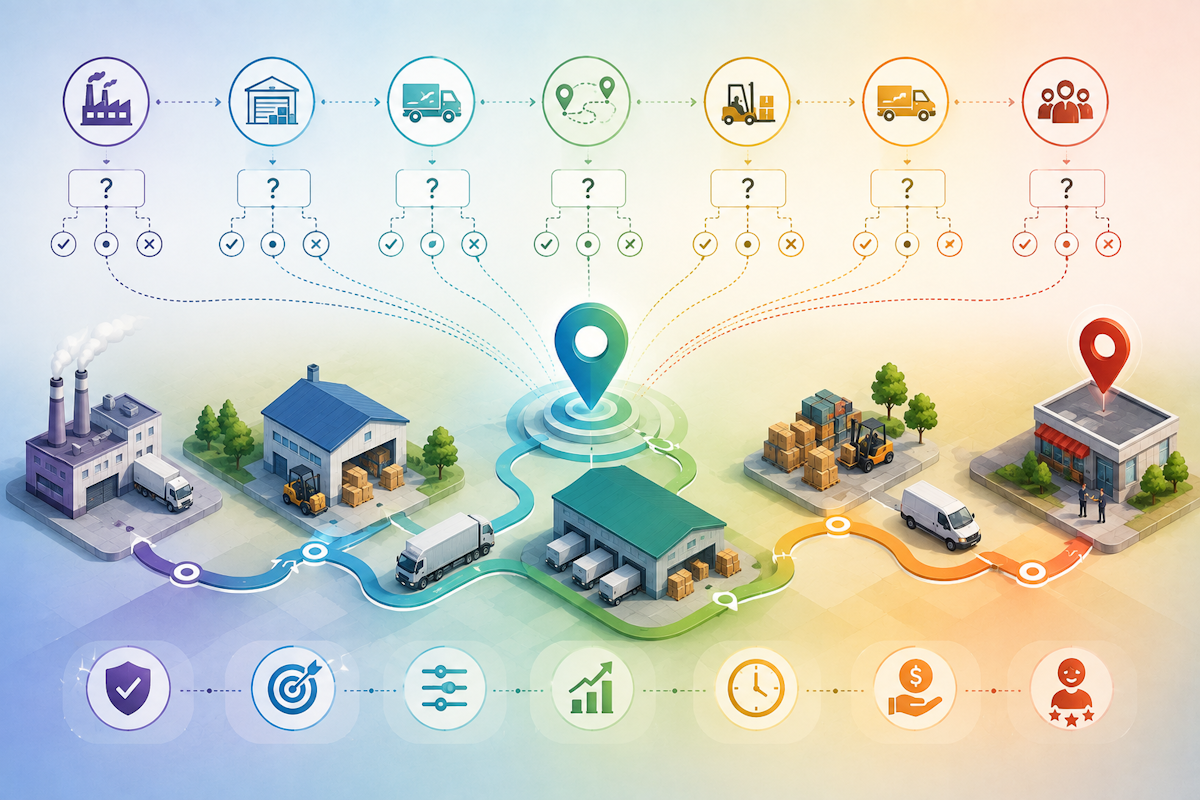
When we think about logistics, we often picture the physical movement of goods. A shipment leaves a supplier, arrives at a warehouse, moves to a distribution center, and eventually reaches the customer. From the outside, logistics looks like a chain of physical movements connecting one location to another.
But behind every movement is a decision.
Which warehouse should receive the goods? Which carrier should transport them? Which route should the driver take? Where should inventory be positioned? When should a shipment leave? Which delivery location should be used? Should two shipments be consolidated or transported separately?
Each of these decisions depends on information. And increasingly, that information is coming from interconnected digital systems that rely heavily on location data.
This means that modern logistics is not simply a chain of movements. It is a chain of decisions, where every decision influences what happens next. When the data behind one decision is inaccurate or inconsistent, the consequences can travel through the rest of the logistics process.
Decisions Connect One Stage of the Supply Chain to the Next
A logistics process rarely consists of one isolated decision. Instead, decisions build on one another.
A supplier location determines where goods are collected. That information influences transportation planning. The chosen route affects the estimated arrival time. The arrival time influences warehouse planning. Warehouse capacity then affects inventory positioning and subsequent transportation decisions.
Each stage depends on information produced or used by the previous stage.
This creates a chain in which an error at the beginning can influence decisions much further downstream. A location that is incorrectly identified in the supplier master data may eventually affect route planning, warehouse scheduling, delivery execution, and customer communication.
The problem may only become visible at the end of the process, even though the original issue occurred much earlier.
Location Data Is Part of Every Decision
Location data is often treated as a technical detail behind logistics operations. In reality, it is one of the inputs that makes many logistics decisions possible.
A transportation system needs to know where a shipment is coming from and where it needs to go. A warehouse needs to know where goods are being received and where they need to be stored or dispatched. A business planning its distribution network needs to understand where customers, suppliers, and facilities are located.
Even decisions that appear unrelated to addresses often depend on location information.
For example, determining where to place a new warehouse requires understanding customer demand and the geographic distribution of deliveries. Evaluating carrier performance requires knowing which locations are being served. Optimizing delivery routes requires accurate destinations and origins.
When location data is incomplete, outdated, or fragmented, the quality of these decisions is affected.
One Incorrect Location Can Influence Multiple Decisions
Consider a distribution center that exists twice in a company's systems because of duplicate location records.
The ERP may treat the records as two separate facilities. The TMS may assign shipments to both locations. The WMS may maintain inventory information under only one of them. Management reports may then show activity across two facilities instead of one.
No single system necessarily appears to be broken.
Yet the business is making decisions based on a fragmented representation of reality.
Transportation planners may allocate shipments incorrectly. Warehouse teams may see incomplete information. Management may make network planning decisions based on misleading data. What started as a duplicate location has now influenced several decisions across the organization.
This is why location data problems are rarely isolated data problems. They become decision-making problems.
Automation Turns Data Into Decisions at Scale
The role of data becomes even more important as logistics operations become increasingly automated.
In a manual environment, an employee may notice that an address looks unusual and correct it before a shipment is dispatched. Automated systems do not necessarily have that same contextual knowledge. They make decisions based on the information available to them.
Route optimization systems select routes based on location information. Automated warehouse processes rely on predefined locations. AI-based planning tools use historical and current data to make recommendations. Predictive systems estimate future demand and transportation requirements based on patterns in the underlying data.
When the data is reliable, automation can make thousands of decisions faster and more efficiently than people can.
When the data is inconsistent, automation can reproduce the same mistake at scale.
The more automated the supply chain becomes, the more important it is to ensure that the information driving those decisions is trustworthy.
A Connected Supply Chain Needs Connected Decisions
Businesses have invested heavily in connecting their logistics systems. ERP, WMS, TMS, CRM, carrier platforms, and other applications increasingly exchange information automatically.
But connecting systems is only part of the challenge.
The decisions made in one system often become inputs for decisions made in another. If the location information changes meaning as it moves between systems, the decision chain becomes fragmented.
A TMS may receive a destination that does not match the location used by the WMS. A carrier may receive a different version of the same address. A customer service platform may show information that differs from what the transportation team sees.
The systems are technically connected, but the decisions are not based on a shared understanding of the same physical locations.
This is where Logistics Continuity becomes essential.
Data Continuity Creates Decision Continuity
If logistics is a chain of decisions, then maintaining continuity in the data behind those decisions is critical.
A location needs to remain identifiable as the same location as information moves from one system to another. Updates need to reach the systems that depend on them. Duplicate records need to be identified so that different teams are not making decisions about the same place as if it were several different locations.
This does not mean every system needs to contain identical information. Instead, they need to maintain a consistent connection to the same underlying location.
When that happens, decisions made across the logistics network are based on a shared foundation.
The Cost of a Broken Decision Chain
When data continuity breaks, businesses often experience the consequences as individual operational problems.
A shipment is sent to the wrong location. A route is longer than necessary. A warehouse receives incomplete information. A customer receives an incorrect delivery estimate. A planner has to manually correct a record.
Each incident may appear unrelated.
But these events can all be symptoms of the same underlying issue: different decisions were made using different versions of the same location.
The cost therefore extends beyond the original data error. Businesses pay through additional transportation, manual work, delays, failed deliveries, inefficient inventory positioning, and reduced customer satisfaction.
The more decisions depend on the same location data, the greater the potential impact when that data is wrong.
Building a Reliable Foundation for Better Decisions
Improving logistics decision-making does not always mean adding another optimization tool or replacing an existing system. Sometimes the most important improvement is ensuring that the systems already in place are working with reliable information.
Organizations can strengthen this foundation by validating location data, matching duplicate records, standardizing core information, maintaining consistent location identifiers, and ensuring that updates remain connected across systems.
With a trusted location foundation, businesses can make better decisions at every stage of the logistics process. Transportation planners can work with more reliable destinations, warehouse teams can operate with greater confidence, and management can use more accurate information when making strategic decisions about their network.
Better decisions begin with better data.
Why This Matters for the Future of Logistics
The logistics industry is moving toward increasingly automated and data-driven operations. AI, predictive analytics, autonomous processes, real-time optimization, and connected supply chain platforms are all designed to help businesses make faster and better decisions.
But these technologies do not change the fundamental principle behind logistics: every decision is only as reliable as the information it is based on.
As the number of automated decisions increases, the importance of consistent location data will increase with it. Businesses will need to know not only where their locations are, but also that every system making decisions about those locations is referring to the same physical reality.
That is what allows a logistics network to operate as one connected system rather than a collection of disconnected decisions.
Conclusion
Logistics is often described as a chain of movements: goods move from suppliers to warehouses, from warehouses to distribution centers, and from distribution centers to customers. But behind every movement is a decision, and behind every decision is data.
When location data is accurate and consistent, these decisions can connect smoothly across the supply chain. When location data becomes fragmented, the decision chain begins to break, creating inefficiencies that may only become visible much further downstream.
This is why Logistics Continuity is about more than keeping addresses clean. It is about maintaining the connection between data and decisions throughout the entire logistics network.
When every system understands the same physical locations, every decision can build on the one before it, and the logistics chain can keep moving as one connected process.
Disclaimer: image created with AI