Why companies don’t realize they have a location data problem until scale hits
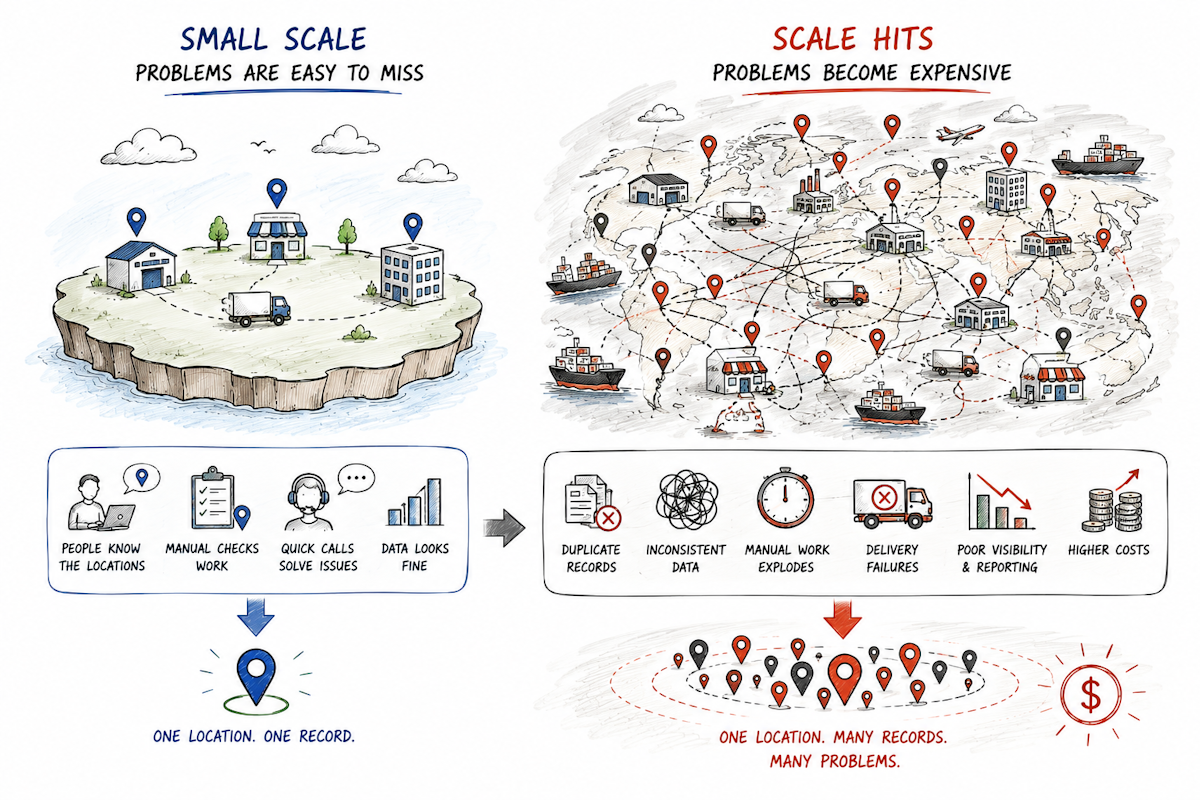
Location data problems rarely look serious when a business is small. A few incorrect addresses can usually be fixed manually. A duplicate customer record can be corrected by an employee. A driver who cannot find a delivery location can simply make a phone call. When there are only a handful of exceptions, these issues feel manageable.
The problem is that they don't stay small.
As companies grow, the number of customers, suppliers, warehouses, shipments, countries, and logistics partners increases rapidly. The same manual processes that once seemed perfectly reasonable begin to consume significant amounts of time and resources. Small inconsistencies that were previously easy to overlook start affecting transportation planning, warehouse operations, reporting, and customer experience.
By the time a business recognizes the problem, location data has often become deeply embedded across its entire technology and logistics environment.
In this blog post, we will explore why location data problems often remain invisible during the early stages of growth, what changes when a business reaches scale, and why addressing data quality early can prevent much larger operational challenges later.
Small Volumes Make Bad Data Easier to Hide
When a business has a relatively small customer base and limited logistics activity, employees can compensate for imperfect data.
A warehouse employee may recognize that two records belong to the same customer. A transportation planner may know which entrance a particular facility uses. A customer service representative may remember that a certain address is outdated. This kind of operational knowledge creates a safety net around poor data.
Because people can correct problems as they encounter them, the underlying data issue remains largely invisible. The business continues operating successfully, even though its systems contain duplicate, incomplete, or inconsistent location records.
At a small scale, human knowledge can compensate for data quality problems. At a larger scale, it becomes impossible.
Growth Multiplies Location Data
As a company expands, its location data grows alongside it. More customers create more delivery addresses. More suppliers introduce more origin locations. New warehouses and distribution centers add additional facilities. Expansion into new countries introduces new address formats, languages, and local conventions. At the same time, more employees and departments begin creating and updating location records. What was once a few hundred locations can quickly become thousands or millions of records distributed across multiple systems.
The challenge is not simply having more data. It is maintaining consistency as that data is created, updated, shared, and transformed across the organization. Without a structured approach, every new record creates another opportunity for duplication or error.
Manual Processes Stop Scaling
One of the clearest signs that a location data problem has reached scale is the growing amount of manual work required to keep operations running.
Employees begin checking addresses before shipments are dispatched. Customer service teams spend more time confirming delivery information. Data teams reconcile records between systems. Transportation planners investigate unexpected routing issues. None of these tasks may appear significant individually. But when they happen hundreds or thousands of times, the accumulated cost becomes substantial. A process that takes two minutes to correct one address may not matter when there are ten exceptions a week. When there are thousands, it becomes a permanent operational workload.
At this point, the organization isn't just managing logistics. It is managing the consequences of its data.
More Systems Create More Opportunities for Inconsistency
Growth rarely means simply adding more customers. Companies also add more technology.
An organization may start with an ERP and later introduce a WMS, TMS, CRM, carrier platforms, e-commerce systems, and specialized logistics tools. Each system may create, store, or modify location information in a slightly different way. The same customer can therefore accumulate multiple records across the technology landscape.
When the business is small, employees may know how those systems relate to each other. As the organization grows, that knowledge becomes fragmented across teams and departments. Eventually, no single person has a complete view of how a location is represented across the business.
Geographic Expansion Makes the Problem More Complex
Scale also often means geographic expansion.
Operating in a second or third country introduces new address structures, postal systems, languages, scripts, and local conventions. A location that is easy to standardize in one market may require a completely different approach in another.
If the business does not have a consistent method for validating and matching locations across countries, geographic expansion can quickly multiply the number of duplicate and inconsistent records. This is particularly challenging for companies managing global supply chains, where a single shipment may involve suppliers, warehouses, carriers, and customers across several countries.
The larger and more international the network becomes, the more important it is to have a common understanding of what each location actually represents.
Technology Growth Can Expose the Problem
Interestingly, businesses often discover their location data problems when they try to become more digital.
A company may implement a new TMS to optimize transportation routes, introduce warehouse automation, or begin using AI to improve forecasting and planning. Suddenly, the systems require location data to be much more accurate and consistent than before. Data issues that were previously hidden by manual processes become impossible to ignore.
An optimization system may identify multiple records for the same destination. An automated warehouse process may encounter conflicting facility information. An analytics platform may produce unexpected results because the same customer appears under several different locations. The technology did not create the problem. It exposed a problem that was already there.
Scale Turns Exceptions Into Patterns
Perhaps the biggest change that happens with scale is that exceptions stop being exceptions. One failed delivery caused by an incorrect address may be an isolated incident. Hundreds of similar failures indicate a systemic problem. One duplicate warehouse record may be harmless. Thousands of duplicate locations spread across multiple systems can distort reporting and operational planning.
This distinction is important because businesses often manage individual location errors rather than addressing the underlying data quality problem. They fix the symptom each time it appears, instead of improving the process that creates the errors in the first place.
At scale, this approach becomes increasingly expensive and difficult to sustain.
Why Location Data Should Be Managed Before Scale Arrives
The best time to establish strong location data practices is before a business reaches the point where poor data becomes an operational constraint.
This means establishing clear standards for how locations are created, validated, matched, updated, and shared across systems. It also means identifying duplicate records and inconsistencies before they become deeply embedded in business processes. A reliable location data foundation allows businesses to scale without continuously increasing the amount of manual effort required to keep their logistics network functioning.
Instead of reacting to location problems as they appear, organizations can prevent many of them from occurring in the first place.
Building a Foundation for Growth
As businesses grow, location data should become more structured, not more fragmented.
Organizations need a consistent way to identify the same physical location across ERP, WMS, TMS, CRM, carrier systems, and other platforms. They need to be able to distinguish between genuine new locations and duplicate records, while also maintaining the local details required for different markets and operational processes.
This creates an important distinction between having location data and being able to trust location data.
A company may have millions of addresses stored across its systems, but if it cannot confidently determine which records represent the same physical locations, that data has limited operational value.
Conclusion
Companies rarely wake up one day with a major location data problem. More often, the problem develops gradually as the business grows.
At small scale, employees can compensate for inaccurate addresses, duplicate records, and inconsistent information through manual knowledge and intervention. As the number of locations, shipments, systems, countries, and partners increases, those workarounds stop being effective.
Scale doesn't necessarily create the location data problem. It makes the existing problem impossible to ignore.
By establishing reliable location data practices before growth turns exceptions into systemic inefficiencies, businesses can build a stronger foundation for transportation, warehouse operations, automation, analytics, and future expansion.
The goal is not simply to keep location data clean as a business grows. It is to ensure that every system, team, and logistics partner continues to understand the same physical locations in the same way.
Disclaimer: image created with AI