What logistics continuity actually means (end-to-end data consistency)
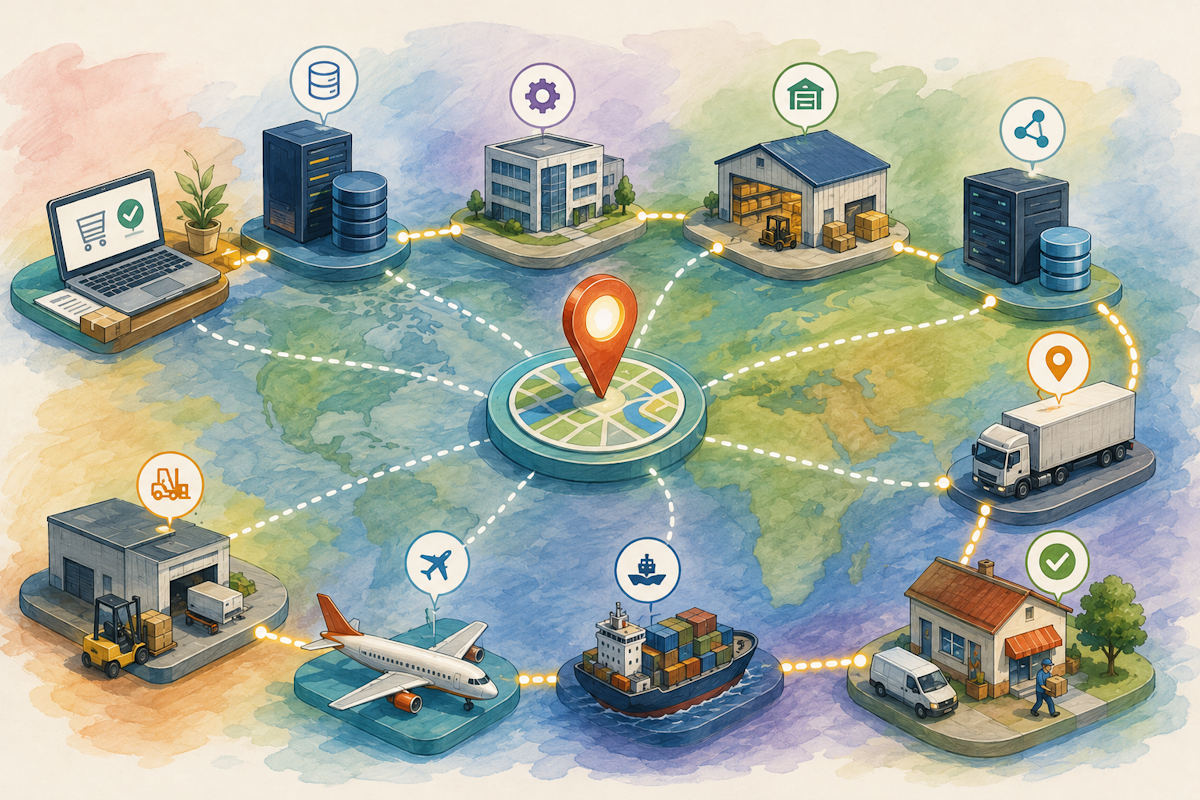
Modern logistics depends on a constant flow of information. A location may first enter a business through a customer order, supplier record, or master data system. From there, it can move through an ERP, WMS, TMS, carrier platform, warehouse, and delivery network before a shipment finally reaches its destination.
At every stage, the information needs to remain connected to the same physical reality.
This is where Logistics Continuity comes in. It is the ability to maintain consistent, reliable, and recognizable location data throughout the entire logistics process, regardless of how many systems, teams, countries, or partners are involved.
The idea sounds simple, but achieving it is much more difficult than simply connecting systems. A business can have highly integrated technology and still have fragmented location data. The real question is not whether information can move from one system to another, but whether the meaning and identity of that information remain consistent throughout the journey.
What Happens When Continuity Is Missing?
Imagine a company shipping goods to a customer warehouse. The customer's address is correctly stored in the ERP, but the TMS contains an older version of the location. The WMS uses a different internal identifier, while the carrier has another variation of the address in its own system.
Every individual record may appear reasonable when viewed separately. Yet together, they create uncertainty about where the shipment is actually supposed to go.
This is where seemingly small data differences become operational problems. The transportation system may plan a route using outdated information. The warehouse may prepare the shipment against a different location record. The carrier may receive incomplete delivery information. Employees then have to step in to determine which version is correct.
The physical location has not changed. The data representing it has.
Logistics Continuity Is About the Entire Journey
End-to-end consistency means that location data remains connected from the moment it enters the organization to the moment it is used in a real-world logistics process.
Consider a supplier location. The supplier provides its address during onboarding. That location enters the ERP, where it becomes part of the supplier master data. When goods are ordered, the location information flows into other systems involved in planning, warehousing, and transportation. Eventually, a carrier uses that information to collect the shipment.
At each stage, the location may need additional operational information, but its underlying identity should remain consistent.
If the same supplier is duplicated in one system, renamed in another, or represented differently in a way that prevents matching, continuity is broken. The further the information travels, the more difficult it becomes to identify and correct the original inconsistency.
Continuity Does Not Mean Every System Looks the Same
One common misconception is that end-to-end consistency means every system should contain exactly the same address in exactly the same format.
That is not realistic, nor is it necessary.
ERP, WMS, and TMS platforms have different purposes, so they naturally require different information. A WMS may need a loading dock, gate, or warehouse zone. A TMS may require coordinates, route restrictions, and delivery instructions. An ERP may focus on customer, supplier, or financial information.
Logistics Continuity does not eliminate these differences. Instead, it ensures that these different pieces of information remain connected to the same underlying physical location.
Each system can continue doing its job while relying on a shared understanding of what location it is actually referring to.
A Location Needs a Reliable Identity
The foundation of continuity is therefore not simply the address itself. It is the ability to identify a physical location reliably across different representations.
An address can change its formatting. A company name can change. A warehouse can receive a new internal code. A location can be represented in different languages or enriched with additional operational information.
The physical place may still be the same.
Businesses need a way to recognize that connection even when the records do not look identical. This is particularly important in international logistics, where address structures, languages, postal formats, and local conventions can vary significantly from country to country.
Without a reliable location identity, every system is left to interpret the data independently.
Continuity Depends on More Than Data Quality
Data quality and Logistics Continuity are closely related, but they are not exactly the same thing.
A company can have clean and accurate addresses in its ERP while still having poor continuity across its logistics network. If the TMS contains different records for the same destinations, or if updates are not transferred to downstream systems, the overall process remains fragmented.
This is why simply cleaning one database is rarely enough.
Businesses need to understand how location information moves through their entire technology landscape and where inconsistencies can appear. The objective is not only to correct bad data but to maintain the connection between systems over time.
That is what turns data quality into operational continuity.
Why Continuity Matters for Automation
The importance of Logistics Continuity becomes even clearer as businesses introduce more automation.
Route optimization, automated warehouse processes, predictive analytics, AI-based planning, and real-time visibility all depend on reliable location information. These technologies can process enormous amounts of data, but they still need to understand what each location actually represents.
If the same warehouse appears as three different locations, an automated system may treat them as separate facilities. If a delivery address is outdated, an optimized route can still lead a driver to the wrong destination. If location identifiers cannot be matched across systems, analytics may produce fragmented results.
Automation does not remove the need for data continuity. It makes it even more important.
Maintaining Continuity as the Network Changes
Logistics networks are constantly changing. Businesses open new facilities, close warehouses, acquire companies, onboard new suppliers, change carriers, expand into new countries, and add new software platforms.
Every change introduces another opportunity for location data to become fragmented.
For this reason, Logistics Continuity cannot be treated as a one-time data-cleaning project. It needs to be maintained as part of the ongoing management of the logistics network.
When a location changes, the change needs to be reflected wherever that location is used. When a new system is introduced, it needs to understand existing location identities. When a new partner is onboarded, their location data needs to connect with the organization's existing data foundation.
Continuity means keeping these connections intact as the business evolves.
From Multiple Systems to One Connected View
The goal is not to eliminate the systems that businesses already rely on. ERP, WMS, TMS, CRM, carrier platforms, and other specialized tools all play an important role in modern logistics.
The goal is to make sure that these systems do not create isolated versions of the same physical world.
When location data is standardized, matched, validated, and consistently connected across platforms, businesses can create a unified view of their logistics network. Teams can work with the information relevant to their role while still knowing that they are referring to the same underlying locations.
This reduces manual reconciliation, improves visibility, supports more reliable automation, and creates a stronger foundation for operational decision-making.
Why Logistics Continuity Is Becoming Essential
As supply chains become more complex, businesses can no longer rely on individual employees to bridge gaps between systems. There are simply too many locations, transactions, partners, and technologies involved.
The companies that will operate most efficiently are not necessarily those with the most systems. They are the ones that can make those systems work together around consistent, trusted data.
Logistics Continuity provides the foundation for that connection. It allows businesses to move information across their logistics network without losing the identity or meaning of the locations that information represents.
Conclusion
Logistics Continuity is about maintaining a consistent understanding of every physical location throughout the entire logistics journey. From the first customer or supplier record to warehouse operations, transportation planning, carrier execution, and final delivery, the same location needs to remain recognizable and trustworthy across every step.
It is not about forcing every system to use identical formats. It is about ensuring that different systems, representations, and operational requirements remain connected to the same underlying reality.
When that continuity exists, businesses can reduce manual work, prevent avoidable logistics errors, improve visibility, and get more value from the technology they already use.
Logistics Continuity starts with a simple principle: one physical location should remain one trusted location, no matter how many systems, processes, countries, or partners it passes through.
Disclaimer: image created with AI