The problem of duplicate locations across systems
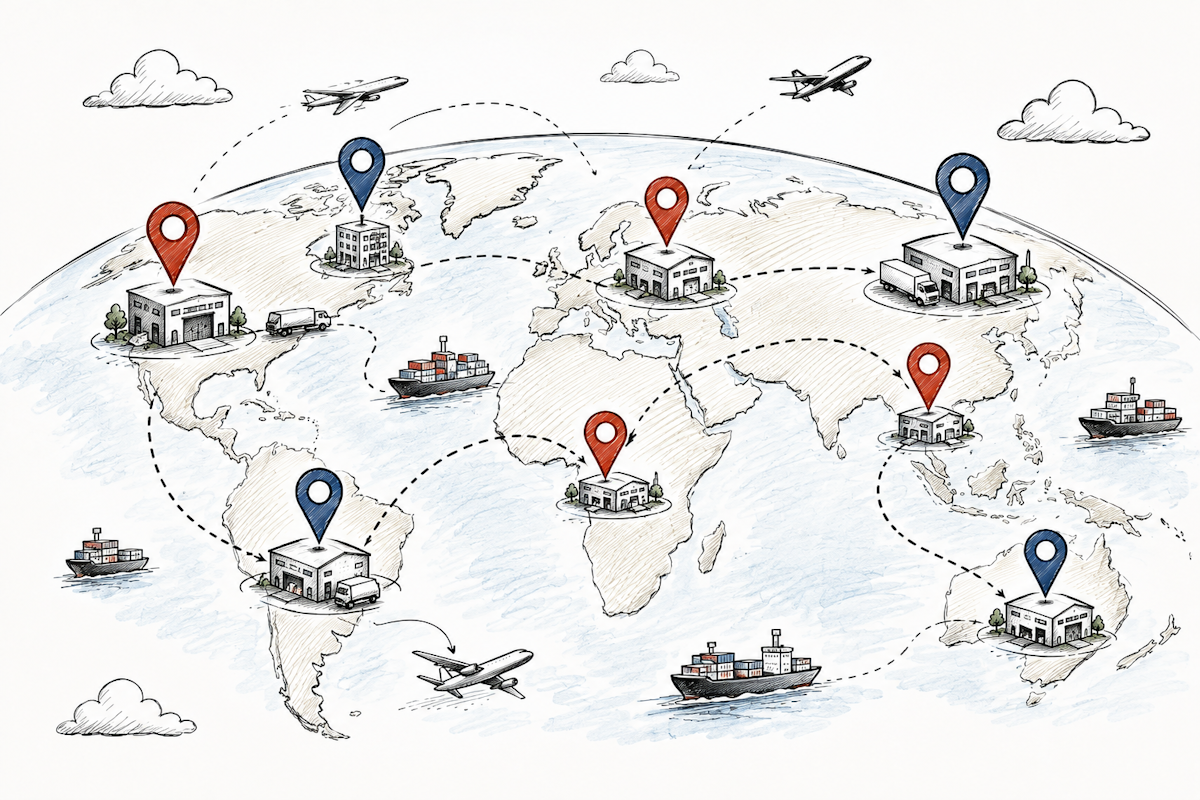
Modern supply chains depend on a wide range of digital systems, each responsible for a different part of the operation. ERP platforms manage customers and suppliers, WMS platforms coordinate warehouse activities, TMS platforms manage transportation, while CRM systems, carrier platforms, and other applications maintain their own location information.
As businesses grow, the same physical locations are often entered into several of these systems. A customer may have one record in the ERP, another in the TMS, and a slightly different version in the WMS. A warehouse may be identified by its full address in one system, an internal facility code in another, and a shortened name in a third.
The problem is not that these records look different. The problem is that systems may not recognize that they represent the same physical location.
When this happens, one real-world location becomes several digital locations, creating inconsistencies that can affect everything from transportation planning and warehouse operations to reporting and customer service.
In this blog post, we will explore why duplicate locations appear across business systems, what problems they create, and why businesses need a consistent approach to identifying and managing locations across their logistics network.
How Duplicate Locations Are Created
Duplicate locations rarely appear all at once. They are usually created gradually as businesses add new systems, onboard new customers, expand into new markets, or make changes to their logistics networks.
A customer may initially be created in an ERP system by a sales or finance team. Later, the same customer is added to a TMS for transportation planning, and a warehouse team creates another record when processing shipments. If the systems use different naming conventions or address formats, each record may look slightly different.
Manual data entry makes the problem even more common. An employee may enter "25 Industrial Road" while another enters "25 Industrial Rd." A third system may store the same location using a customer ID or facility code rather than the full address.
All of these records can refer to exactly the same physical place, but without a reliable way to match them, the systems treat them as separate locations.
Why One Location Becomes Several
There are many reasons why the same location can be represented differently across systems. Address formatting is one of the most obvious, but it is far from the only issue.
Different systems may use different naming conventions, internal identifiers, postal code formats, languages, or levels of detail. One platform may store a billing address while another stores a delivery address. A warehouse system may include a specific loading dock, while the ERP only contains the main facility address.
Changes over time can create additional versions of the same location. A company may move to a new facility, change its legal name, open another entrance, or update its delivery instructions. If those changes are made in one system but not another, the organization can quickly end up with multiple records that partially describe the same place.
The result is not necessarily obviously incorrect data. Instead, it is fragmented data.
Duplicate Locations Create Operational Confusion
Once duplicate locations exist, they begin to affect everyday logistics processes.
A transportation system may treat two records as separate delivery destinations even though they are located at the same facility. A warehouse may receive shipment instructions using one location identifier while the transportation team uses another. Customer service may see an address that does not match the information being used by the carrier.
These inconsistencies force employees to manually compare records and determine which version is correct.
In some cases, the problem is resolved before it affects the customer. In others, it results in a failed delivery, a delayed shipment, or additional transportation. Either way, the business is using valuable resources to solve a problem that began with two systems failing to recognize the same location.
Duplicate Data Distorts Business Reporting
The impact of duplicate locations goes beyond day-to-day logistics.
Businesses increasingly rely on data to understand their supply chains and make strategic decisions. They analyze shipment volumes, transportation costs, customer demand, supplier performance, and warehouse activity to identify opportunities for improvement.
Duplicate locations can distort these analyses.
If the same customer appears under multiple location records, shipment volumes may be divided between them. A warehouse may appear as several facilities in a report. Transportation costs may be associated with different versions of the same destination.
This makes it harder to understand what is actually happening across the logistics network.
When the underlying location data is fragmented, even sophisticated analytics can produce an incomplete picture of the business.
Integration Can Spread the Problem
Connecting systems is an important part of digital transformation, but integration alone does not solve duplicate location data.
In fact, integrations can sometimes make the problem more difficult to manage.
When systems are connected, location records are continuously exchanged between them. If duplicate or inconsistent records already exist, those records can spread across additional platforms and become part of more operational processes.
The organization may appear more connected from a technology perspective while becoming increasingly fragmented from a data perspective.
This is why businesses need to distinguish between systems being connected and data being consistent. Integration allows information to move. It does not necessarily ensure that the information means the same thing everywhere it appears.
The Hidden Cost of Duplicate Locations
Duplicate locations create a wide range of costs, many of which are difficult to identify because they are distributed across different parts of the organization.
Transportation teams spend time resolving address discrepancies. Warehouse employees correct shipment records. Customer service teams handle delivery issues. Data teams reconcile conflicting records. Management receives reports that may not accurately represent the underlying logistics network.
There are also direct operational costs, including additional mileage, failed deliveries, unnecessary shipments, manual corrections, and inefficient route planning.
Individually, these issues may appear minor. Across thousands of locations and millions of transactions, however, they can become a significant source of unnecessary cost and complexity.
Creating One Trusted Location Across Systems
The solution is not necessarily to make every system store the exact same information. Different applications need different details to perform their specific functions.
Instead, organizations need a common location identity that allows every system to understand when different records represent the same physical place.
This means matching duplicate locations, standardizing core location information, validating addresses, maintaining consistent identifiers, and ensuring that changes can be reflected across connected systems.
With a trusted location foundation, an ERP can continue managing customer and financial information, a WMS can manage warehouse-specific details, and a TMS can manage transportation requirements—all while referencing the same underlying physical location.
This creates consistency without requiring every system to operate in exactly the same way.
Why Businesses Must Address This Now
The problem of duplicate locations becomes more serious as logistics networks become larger and more connected. Every new system, country, carrier, supplier, or customer creates another potential source of location data.
At the same time, businesses are investing in automation, artificial intelligence, predictive analytics, and advanced optimization tools. These technologies depend on reliable data to make accurate decisions.
If the same location is represented by several conflicting records, businesses cannot fully trust the information flowing through their systems.
Cleaning up duplicate locations is therefore not simply a data management exercise. It is a necessary step toward building a more connected and efficient digital supply chain.
Conclusion
A physical location should represent one place, but in modern logistics it can easily become several different records spread across multiple systems.
Duplicate locations create operational confusion, increase manual work, distort reporting, and contribute to unnecessary transportation and warehouse costs. More importantly, they make it difficult for businesses to maintain a consistent understanding of their own logistics network.
The solution is to establish a reliable way to identify, match, and maintain locations across systems. When every platform can recognize the same physical place as the same location, businesses can reduce complexity and create greater continuity across their operations.
Disclaimer: image created with AI