The hidden cost of duplicate or incorrect addresses in logistics networks
Every shipment in a logistics network begins with a destination. Whether goods are moving from a supplier to a warehouse, between distribution centers, or directly to a customer, every process depends on one simple assumption: the destination is accurate.
Unfortunately, this assumption is often wrong.
Across many organizations, duplicate, outdated, and inconsistent address records exist in ERP, WMS, TMS, CRM, and other business systems. These issues rarely attract attention because they do not always cause immediate failures. Instead, they quietly introduce inefficiencies that accumulate over time, increasing costs across transportation, warehousing, customer service, and planning.
Unlike a delayed shipment or a system outage, poor address quality often remains invisible. Businesses continue operating, but with unnecessary complexity built into almost every logistics process.
In this blog post, we will examine why duplicate and incorrect addresses are more than just data quality issues and how they create hidden costs throughout modern logistics networks.
Duplicate Addresses Are More Common Than Most Businesses Realize
As organizations grow, so does the number of systems managing location information.
Customer records may be created by sales teams, supplier locations maintained in procurement systems, warehouse destinations managed in operational platforms, and delivery addresses updated by customer service teams. Without a centralized approach to location management, multiple versions of the same address quickly begin to appear.
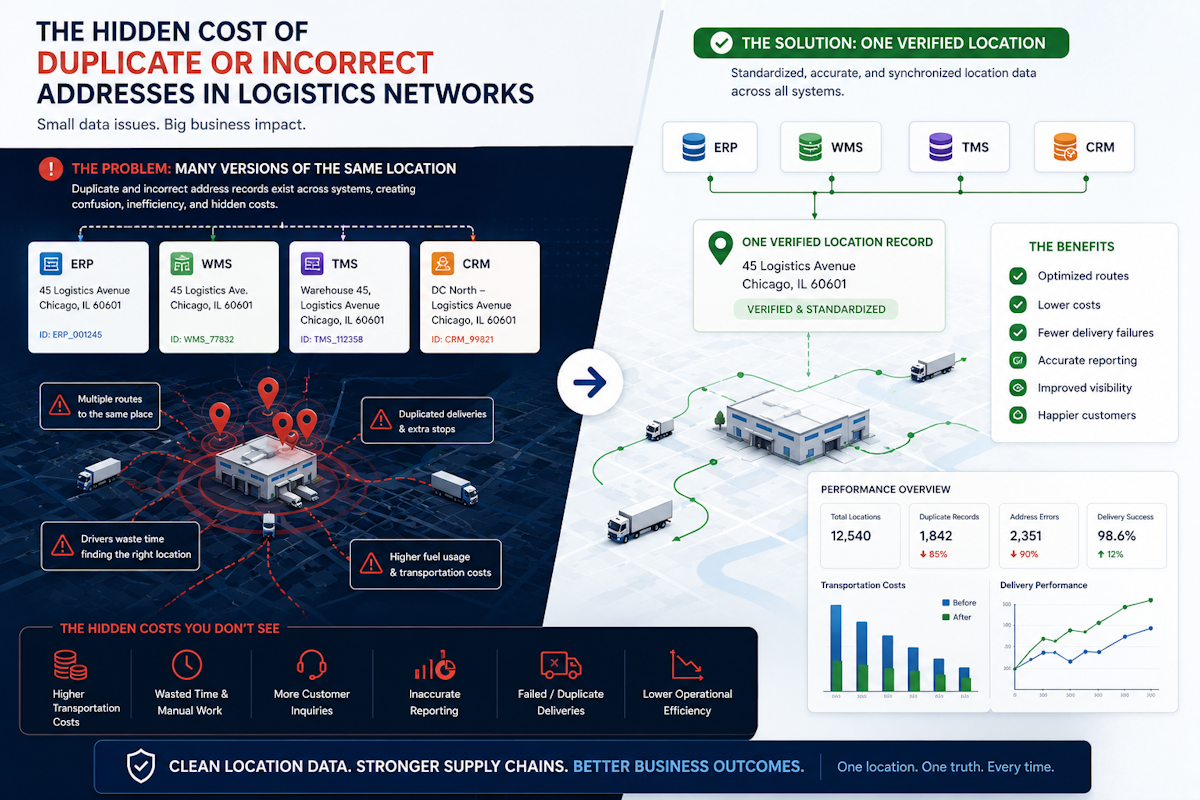
For example, one warehouse may be stored as:
- 45 Logistics Avenue
- 45 Logistics Ave.
- Warehouse 45, Logistics Avenue
- DC North – Logistics Avenue
Although these records represent the same physical location, many systems treat them as entirely separate destinations.
Over time, duplicate records become part of everyday operations without anyone noticing.
Incorrect Addresses Create Continuous Operational Friction
Incorrect addresses are not always completely wrong.
More often, they are almost correct. A missing unit number, an outdated postal code, or an incorrect entrance can be enough to interrupt logistics operations.
These small inaccuracies create continuous friction across the supply chain.
Drivers spend additional time locating destinations. Warehouse teams manually verify shipment details. Customer service departments respond to avoidable delivery inquiries. Planning teams work with incomplete or inconsistent information.
Each delay may only take a few minutes, but across thousands of shipments those minutes become hours, days, and significant operational costs.
Transportation Costs Increase Without Anyone Realizing
One of the biggest challenges with poor location data is that its financial impact is difficult to measure.
Unlike fuel prices or carrier invoices, duplicate addresses rarely appear as a direct expense.
Instead, they contribute to costs such as:
- Additional mileage
- Longer delivery routes
- Failed delivery attempts
- Driver overtime
- Increased fuel consumption
- Manual shipment corrections
- Extra customer support activities
Because these costs are distributed across different departments, organizations often fail to recognize location data as the common source of the problem.
The result is a steady increase in logistics costs without a clear explanation.
Duplicate Records Reduce Visibility
Modern supply chains depend on accurate reporting.
Businesses analyze transportation performance, warehouse productivity, delivery reliability, supplier performance, and customer demand using data generated across multiple systems.
When duplicate or inconsistent addresses exist, those reports become less reliable.
For example, the same customer may appear multiple times in performance reports, transportation costs may be assigned to different versions of the same destination, and warehouse activity may be fragmented across duplicate location records.
Without a single, trusted version of each location, organizations lose the visibility needed to make informed operational and strategic decisions.
Automation Cannot Fix Bad Data
Automation continues to transform logistics operations.
Artificial intelligence, automated planning, warehouse robotics, and route optimization all promise greater efficiency and lower operating costs.
However, these technologies rely on one critical input: high-quality location data.
If duplicate or incorrect addresses already exist, automation simply processes them faster.
An optimized route to the wrong destination is still the wrong route.
A warehouse robot working from duplicate inventory locations still creates operational inefficiencies.
Technology improves execution, but it cannot compensate for poor data quality.
Why Address Quality Should Be a Business Priority
Location data should no longer be viewed as an administrative responsibility.
It affects transportation, warehousing, customer service, procurement, compliance, finance, and executive decision-making.
Organizations that actively manage address quality benefit from:
- More efficient transportation planning
- Faster warehouse operations
- Improved delivery performance
- Better reporting accuracy
- Lower operational costs
- Greater confidence in business decisions
Most importantly, they create a reliable foundation for future digital transformation initiatives.
As supply chains continue to become more connected, accurate location data becomes increasingly valuable.
Looking Beyond Individual Systems
One of the biggest reasons duplicate addresses persist is that businesses often manage location data separately within each system.
An ERP platform maintains one version, the WMS maintains another, and the TMS stores yet another.
Instead of asking whether each system contains correct data, organizations should ask whether every system shares the same trusted version of each location.
Only then can businesses eliminate duplicate records, improve operational consistency, and create a truly connected logistics network.
Conclusion
Duplicate and incorrect addresses rarely generate headlines within an organization, but they quietly affect nearly every logistics process.
They increase transportation costs, reduce warehouse efficiency, create reporting inaccuracies, generate unnecessary manual work, and undermine customer satisfaction. Most importantly, they prevent businesses from achieving the full value of their digital supply chain investments.
As logistics networks continue to expand, maintaining a single, accurate, and standardized view of every location is no longer simply a data management objective—it has become a competitive advantage.