Return logistics (reverse logistics) as a cost multiplier of bad data
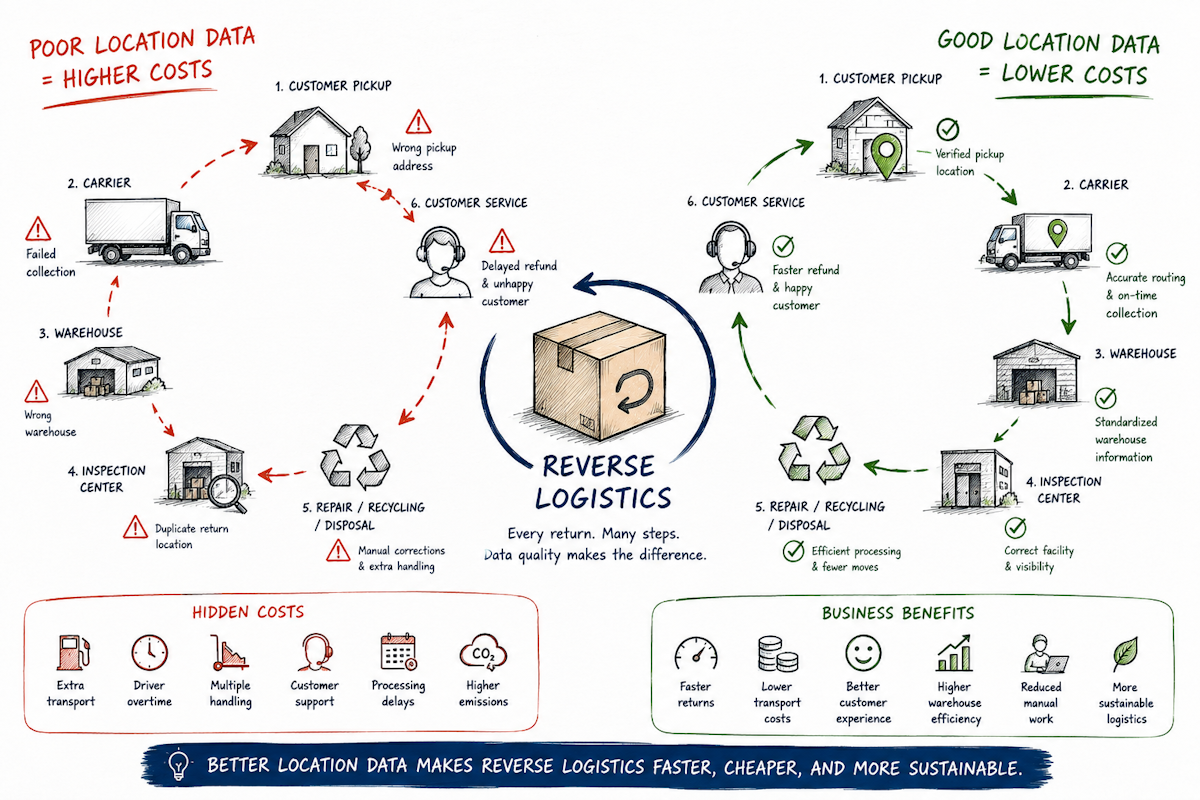
Returns have become an unavoidable part of modern supply chains. Whether driven by e-commerce growth, product exchanges, warranty claims, repairs, or recycling programs, reverse logistics has evolved from a secondary process into a critical component of logistics operations.
For many businesses, however, reverse logistics is also one of the most expensive parts of the supply chain. Unlike outbound deliveries, returns involve multiple touchpoints, additional transportation, inventory inspections, warehouse processing, and customer communication. Every unnecessary delay or error adds cost.
One factor that is often overlooked is the role of location data.
Incorrect, incomplete, or inconsistent location information doesn't only affect outbound shipments—it creates even greater challenges when products need to move back through the supply chain. In fact, poor location data can multiply the cost of reverse logistics by introducing delays, failed collections, manual corrections, and unnecessary transportation.
In this blog post, we will explore why reverse logistics is especially vulnerable to bad location data and how improving location data quality can significantly reduce return-related costs.
Reverse Logistics Is More Complex Than Forward Logistics
Delivering a product is usually a standardized process.
Products leave a warehouse, travel through predefined transportation networks, and arrive at a known destination. Reverse logistics is much less predictable.
Returned goods may originate from residential addresses, retail stores, repair centers, service partners, or temporary collection points. Products may be sent to different warehouses depending on their condition, warranty status, or intended next step.
Every return involves multiple location decisions.
If any of those locations are inaccurate or inconsistent, the entire process becomes slower, more expensive, and more difficult to manage.
Small Location Errors Create Big Return Problems
Because reverse logistics often involves many different parties, accurate location information becomes even more important.
Common problems include:
- Incorrect customer pickup addresses
- Outdated return center locations
- Missing warehouse receiving information
- Incorrect carrier collection points
- Duplicate facility records
- Incomplete delivery instructions
- Incorrect loading dock information
A customer waiting for a product pickup may miss their scheduled collection because the carrier cannot locate the address.
A returned product may arrive at the wrong warehouse, requiring additional transportation before it can be inspected.
A repair center may receive products intended for another facility simply because location records were inconsistent across systems.
These situations increase operational costs while creating a poor customer experience.
Every Failed Return Costs More Than a Failed Delivery
Unlike outbound shipments, reverse logistics rarely ends after one transportation movement.
A returned product may need to travel through several locations before reaching its final destination. It may require inspection, refurbishment, repackaging, recycling, or disposal.
When location data is inaccurate, every additional movement creates new costs.
Businesses may incur:
- Failed pickup attempts
- Additional transportation
- Manual shipment coordination
- Extra warehouse handling
- Increased customer support activity
- Delayed refunds or replacements
- Inventory processing delays
Because reverse logistics already involves multiple operational steps, poor location data amplifies costs at every stage.
A single address error can affect the entire return journey.
Poor Data Reduces Return Visibility
One of the biggest challenges in reverse logistics is maintaining visibility throughout the return process.
Customers want to know when products will be collected, where they are being processed, and when refunds or replacements will be completed.
Businesses need accurate information to monitor inventory, allocate warehouse capacity, and forecast return volumes.
When location data is inconsistent, visibility suffers.
Organizations struggle to answer questions such as:
- Where is the returned product currently located?
- Which warehouse should receive it?
- Has the product reached the correct inspection facility?
- Which carrier is responsible for the next movement?
Without accurate location data, managing reverse logistics becomes significantly more complex.
Manual Processes Increase Costs Even Further
Many organizations rely on manual intervention to resolve location-related issues during returns.
Customer service teams confirm pickup addresses. Warehouse employees redirect shipments. Transportation planners update destination records. Carriers contact customers to clarify collection details.
While these manual processes help prevent complete operational failures, they also consume significant time and resources.
Instead of allowing reverse logistics to operate efficiently, businesses spend valuable effort correcting preventable data issues.
As return volumes continue to grow, these manual workarounds become increasingly expensive.
Sustainability Is Also Affected
Reverse logistics plays an important role in sustainability initiatives.
Many organizations are investing in product refurbishment, recycling, circular supply chains, and waste reduction programs.
However, inefficient transportation caused by poor location data directly undermines these efforts.
Unnecessary vehicle movements, repeated pickup attempts, incorrect routing, and avoidable warehouse handling increase fuel consumption, carbon emissions, and resource usage.
Improving location data quality not only reduces operational costs but also helps businesses achieve their environmental objectives by eliminating unnecessary transportation.
Building More Efficient Reverse Logistics
Reducing the cost of returns begins with improving the quality of location data throughout the entire return journey.
Organizations should focus on:
- Validating pickup and return addresses
- Standardizing location information across systems
- Eliminating duplicate warehouse and facility records
- Enriching locations with operational details such as access instructions and receiving points
- Maintaining consistent location data between ERP, WMS, TMS, customer service platforms, and carrier systems
- Continuously monitoring and updating location records
By creating a reliable location data foundation, businesses can reduce failed collections, improve processing times, and make reverse logistics significantly more efficient.
Why Businesses Should Act Now
Return volumes continue to increase across nearly every industry.
As customer expectations for fast refunds, easy returns, and sustainable logistics grow, organizations can no longer afford inefficient reverse logistics processes.
Businesses that continue operating with poor location data will face rising transportation costs, longer processing times, and lower customer satisfaction.
Those that invest in accurate, standardized, and continuously maintained location data will improve operational efficiency while reducing the overall cost of returns.
In an increasingly competitive marketplace, efficient reverse logistics is becoming a key differentiator—and reliable location data is one of the foundations that makes it possible.
Conclusion
Reverse logistics is already one of the most complex and costly parts of the supply chain. Poor location data makes it even more expensive.
Incorrect pickup locations, inconsistent warehouse records, duplicate addresses, and incomplete location information create unnecessary transportation, increase manual work, delay processing, and reduce visibility throughout the return journey.
By improving location data quality, businesses can simplify reverse logistics, lower operational costs, improve customer experiences, and support more sustainable supply chain operations.