Most logistics problems don’t start in transport, they start in data continuity
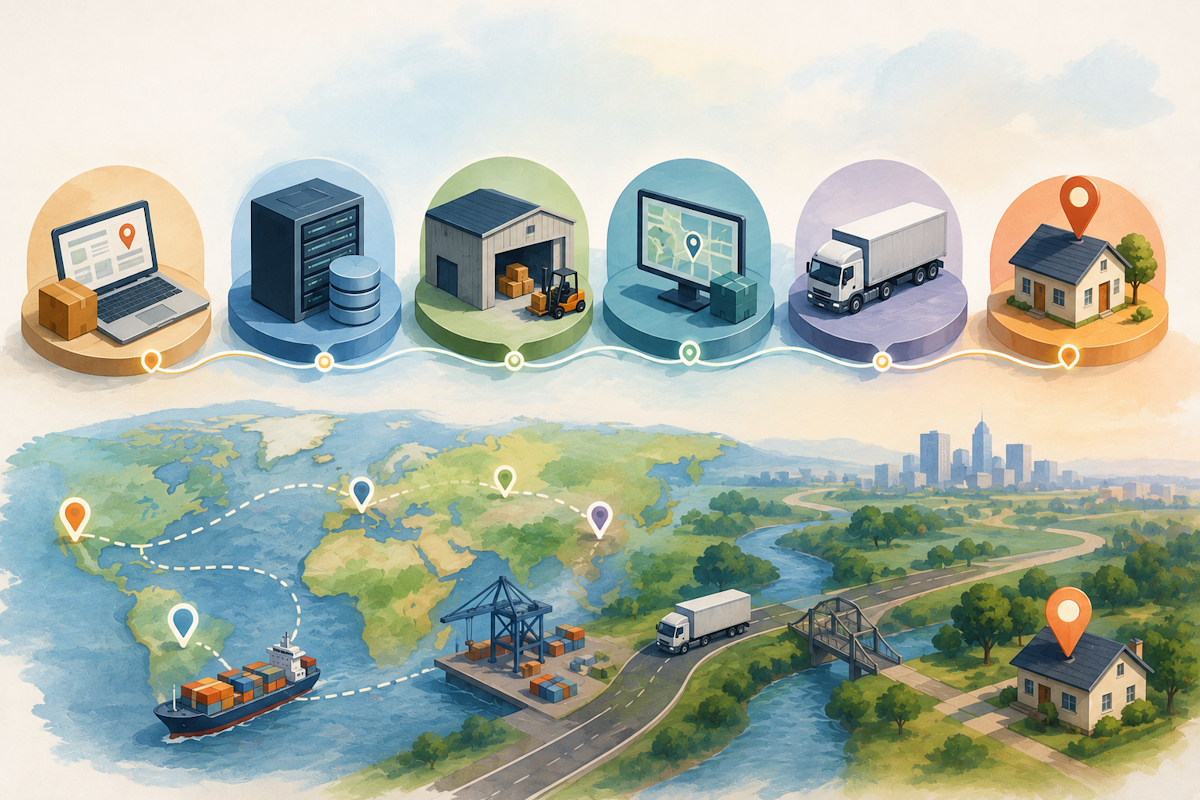
When a delivery is late, a shipment is rerouted, or a driver cannot find the correct destination, the immediate assumption is often that something went wrong in transportation. The carrier may be questioned, the route may be reviewed, or the driver may be asked to explain what happened. But in many cases, the problem started much earlier, before the shipment ever entered the transportation network.
Modern logistics depends on a continuous flow of information between systems, teams, warehouses, carriers, suppliers, and customers. A location is created in one system, updated in another, enriched with operational information somewhere else, and eventually used by a transportation system to plan and execute a delivery. When that information changes or becomes inconsistent along the way, the physical movement of goods can be affected.
This is the challenge of data continuity. It is not enough for location data to be accurate in one system at one particular moment. It needs to remain accurate, identifiable, and consistent as it moves through the entire logistics process. When that continuity breaks, operational problems often appear downstream, where they are much more expensive and visible.
The Transport Network Only Works as Well as the Data Behind It
Transportation teams work with information that has already been created somewhere else in the supply chain. Addresses, warehouse locations, customer destinations, supplier sites, delivery instructions, and geographic coordinates are all inputs into transportation planning.
If that information is reliable, transportation systems can optimize routes, assign shipments, calculate ETAs, and plan vehicle capacity effectively. If the information is incomplete or inconsistent, the system has to make decisions based on imperfect inputs.
Consider a simple example. A customer updates their delivery address, but the change is made only in the CRM system. The ERP still contains the old address, while the TMS continues receiving the outdated version. From the perspective of the transportation team, nothing appears to have changed. The route is planned correctly according to the information available to the system, but the shipment is still going to the wrong place.
The transport process has not necessarily failed. The information reaching transport was already broken.
Location Data Moves Through the Supply Chain
A single location can pass through many different systems before it becomes part of a completed delivery. A customer address may originate in an online order, move into an ERP, be transferred to a warehouse system, and then be sent to a transportation platform or carrier. At every stage, the location needs to remain recognizable as the same physical place.
This becomes increasingly difficult as supply chains become more connected. Every additional system and partner creates another point where information can be reformatted, duplicated, overwritten, or lost.
A warehouse might use an internal facility ID while a carrier uses an address and a transportation system uses coordinates. A supplier may provide an address in a local format while a global company stores it according to a standardized international format. These differences do not necessarily indicate that the data is wrong, but they can make it difficult for systems to recognize that different records refer to the same location.
Without continuity between these representations, information becomes fragmented as it travels through the network.
When Data Changes, the Change Needs to Travel Too
Location data is not static. Businesses move offices and warehouses, open new distribution centers, change delivery points, update customer addresses, and add new facilities. Even smaller operational details can change, such as loading dock locations, access points, or delivery instructions.
The challenge is ensuring that those changes reach every system and partner that depends on them.
If a warehouse moves its receiving entrance but only updates its internal system, the transportation provider may continue using the old information. If a customer changes their address but the update does not reach the TMS, the delivery may still be planned using outdated data. If a supplier's location is duplicated during onboarding, different departments may begin using different records for the same facility.
A location update is therefore only as useful as its ability to remain consistent across the logistics network.
Broken Continuity Creates Problems That Look Unrelated
One of the reasons data continuity problems are difficult to identify is that their consequences often appear far away from the original source.
A duplicate location created during customer onboarding might eventually lead to an incorrect transportation report. An outdated warehouse address might result in a failed delivery. An inconsistent location identifier might prevent two systems from matching shipment information correctly. A formatting difference between countries might create duplicate facilities in a global database.
By the time the problem becomes visible, the original data issue may be several systems and several operational steps away.
This makes it tempting to treat every incident as an individual logistics problem. A failed delivery becomes a carrier issue. A routing error becomes a planning issue. A warehouse discrepancy becomes a warehouse issue. But when the same types of problems continue appearing across different processes, the underlying issue may be the continuity of the data connecting those processes.
Integration Is Not the Same as Continuity
Businesses have spent years connecting their logistics systems. ERP, WMS, TMS, CRM, carrier platforms, and other applications increasingly exchange information automatically.
But simply moving data from one system to another does not guarantee continuity.
An integration can successfully transfer an incorrect address. It can synchronize a duplicate location. It can send an outdated record to another system without anyone realizing that the information is no longer valid.
This is an important distinction. Integration determines whether data can move. Data continuity determines whether that data remains meaningful and trustworthy as it moves.
For modern logistics networks, both are necessary.
Why Data Continuity Becomes More Important at Scale
The larger a logistics network becomes, the harder it is to manage location information manually. A small company may be able to resolve individual inconsistencies through employee knowledge and direct communication. A global logistics operation cannot rely on people remembering which version of an address is correct.
Scale introduces more locations, more transactions, more systems, more countries, and more partners. It also means that the same location is likely to appear in more places across the organization.
Without a consistent location data foundation, every additional connection creates another opportunity for information to diverge.
This is why businesses often discover their location data problems when they reach a certain level of complexity. The underlying inconsistencies may have existed for years, but once the network becomes large enough, manual workarounds can no longer hide them.
Creating Continuity Across the Logistics Network
Maintaining data continuity starts with giving every physical location a reliable identity that can be recognized across systems. Addresses need to be standardized and validated, duplicate locations need to be identified, and changes need to be reflected consistently throughout the network.
This does not mean every system needs to store exactly the same information. A WMS will still need warehouse-specific details, while a TMS requires transportation information and an ERP may need financial or customer-related data. What matters is that all of these systems can connect their operational information to the same trusted underlying location.
When that foundation exists, businesses can move information between systems without constantly questioning whether two records represent the same place.
From Data Quality to Logistics Continuity
Location data quality is often discussed as a problem of cleaning addresses. But in a modern supply chain, the challenge is much broader.
A clean address in one database is useful, but it does not solve the problem if the same location is duplicated in another system, represented differently by a carrier, or updated in one platform and left unchanged everywhere else.
The real objective is to maintain continuity: the ability to recognize, understand, and trust a location throughout its entire journey across the logistics network.
That is what allows transportation, warehousing, planning, customer service, and other operational processes to work from the same foundation.
Conclusion
Most logistics problems do not suddenly appear when a vehicle leaves the warehouse. They often begin much earlier, when location information is created, transformed, duplicated, or updated across different systems without maintaining a consistent connection to the physical location it represents.
By the time the problem reaches transportation, it may look like a routing failure, a missed delivery, or a carrier issue. But the underlying cause can be a break in data continuity that occurred much earlier in the process.
As logistics networks become more digital and interconnected, businesses need to look beyond individual systems and individual addresses. They need to ensure that location information remains accurate, identifiable, and trustworthy wherever it travels.
That is the foundation of Logistics Continuity: keeping location data connected from the first system that creates it to the final step where goods reach their destination.
Disclosure: Image created with AI