I need this one as well: The lifecycle of a location record across supply chain systems
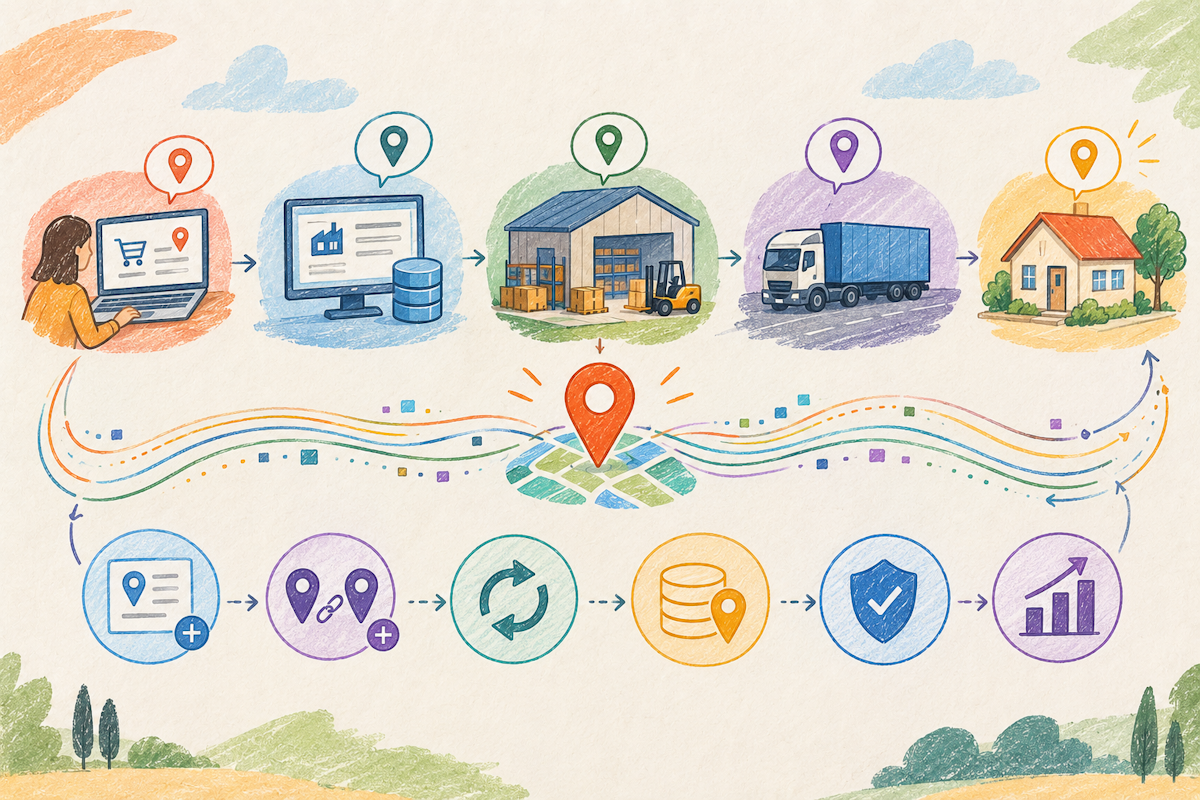
A location record may look like a simple piece of information: a company name, an address, a postal code, perhaps a set of coordinates. But within a modern supply chain, that record rarely stays in one place. It is created, copied, enriched, transformed, shared, updated, and reused across multiple systems and processes. The same physical location can appear in an ERP when an order is created, in a WMS when goods are prepared, in a TMS when transportation is planned, and in a carrier or delivery system when the shipment reaches its final stage.
This means that a location record has a lifecycle of its own. At every stage, information can be added or changed, but it can also become inconsistent, duplicated, outdated, or disconnected from the original record. Understanding this lifecycle is important because location data does not simply exist in a supply chain — it moves through it. And if its identity and meaning are not preserved along the way, the physical movement of goods can continue while the information supporting that movement gradually breaks down.
Where a Location Record Begins
Every location record starts with a business event. A new customer is created, a supplier is onboarded, a warehouse is opened, or a delivery location is added to an existing account. At this point, the business usually captures a set of basic details such as the name of the location, street address, postal code, city, country, and possibly contact information.
The quality of this initial record depends heavily on how the information was collected. It may have been entered manually by an employee, imported from another database, submitted by a customer, received from a supplier, or generated through an external system. The result can therefore vary considerably. One location may have a complete structured address, while another may contain abbreviations, missing fields, local formatting, or information entered as free text. At the moment of creation, these differences may not appear significant. As the record moves through the supply chain, however, they can become increasingly important.
The ERP Creates the First Operational Identity
For many organizations, the ERP is one of the first major systems in which a location receives an operational identity. A customer, supplier, plant, warehouse, or business partner is assigned a record that can be connected to orders, invoices, contracts, purchasing activities, and other business processes.
But the ERP record is primarily designed to support enterprise processes. Its structure and requirements may not be the same as those of transportation or warehouse systems. An address that is perfectly usable for billing may not contain everything required for routing or physical delivery. In some cases, the location is also represented differently depending on whether it is used as a billing address, shipping address, supplier site, or organizational location.
This is where the lifecycle of the location record begins to branch. The business may still be dealing with one physical place, but different systems begin creating their own representations of it.
The Warehouse Adds Operational Context
When an order reaches the warehouse, the location record becomes part of a different operational environment. The WMS may need information relevant to receiving, picking, staging, loading, or shipping. A customer location may now be associated with delivery instructions, loading requirements, time windows, dock information, or other operational attributes.
At this stage, additional data can make the location record more useful. But it can also create another version of the same location. If the WMS receives an address through an interface and stores it independently, changes made later in the ERP may not automatically be reflected in the warehouse system. Alternatively, the warehouse may modify the address locally because it needs a more operationally accurate description.
The record has now evolved, but not necessarily in a coordinated way. Two systems may contain information about the same physical location while neither system has a complete view of how the two records relate to each other.
The TMS Turns the Location Into a Transport Point
Once transportation planning begins, the location takes on another role. In the TMS, it becomes a pickup point, delivery point, stop, terminal, depot, or other transport node. At this stage, the system may require information that is especially important for route planning and execution, such as coordinates, geofences, access restrictions, opening hours, or transport-specific instructions.
This transformation is important because transportation systems do not simply need to know what an address says. They need to know where the physical location actually is and how a vehicle can interact with it.
If the location record entering the TMS is incomplete or inaccurate, planners may have to correct it manually, rely on external mapping data, or work with an approximation. Over time, these corrections can create yet another version of the location. The original ERP record, the warehouse record, and the transport record may all refer to the same place while containing slightly different information.
The Carrier Receives Another Representation
The lifecycle does not stop inside the company's own systems. Once a shipment is handed over to a carrier or logistics service provider, location data often crosses another organizational boundary.
The carrier may use its own transportation platform, routing system, or delivery application. The location might be reformatted, geocoded, enriched, or mapped to an internal location identifier. A carrier may also have its own historical record for the same customer or delivery site based on previous shipments.
This creates a particularly important challenge: the same physical location can now exist across different companies, databases, and technology environments. The shipper may identify it using one internal code, the carrier may use another, and a mapping or geocoding service may represent it differently again. The physical location has not changed, but its digital identity has multiplied.
Delivery Is the Final Operational Test
At the final stage, the location record becomes directly connected to physical execution. A driver or delivery team needs to reach the correct place, at the correct entrance, within the expected time window. What may have looked like a small data inconsistency earlier in the lifecycle can now become a missed delivery, additional mileage, a failed attempt, or a customer service issue.
This is why the lifecycle of a location record matters so much. Problems are often not created at the point where they become visible. A driver struggling to find a delivery point may be dealing with a problem that originated when an address was first entered, when a record was duplicated between systems, or when an update failed to propagate from one platform to another.
The final delivery is therefore not just the end of the physical journey. It is also where the quality and continuity of everything that happened to the location record along the way are put to the test.
What Happens When a Location Changes?
Locations are not static. Companies move offices, warehouses change entrances, suppliers relocate facilities, and customers update their delivery instructions. Even a relatively small physical change can require updates across multiple systems.
The challenge is ensuring that the change reaches every system and partner that depends on the location. If an address is updated in the ERP but remains unchanged in the WMS, TMS, or carrier database, the organization has created multiple versions of the current reality. The record may still look valid in every individual system, but the systems no longer agree.
This is one of the clearest examples of why data continuity is different from simply having accurate data. A location can be correct in one system and incorrect in another. What matters operationally is whether the right version of the location is available wherever and whenever it is needed.
The Lifecycle Creates a Data Chain
A location record therefore moves through a chain that can include customer or supplier onboarding, ERP, WMS, TMS, carrier systems, routing platforms, delivery applications, and eventually back into business reporting and analytics. At every step, the record can gain valuable context, but it can also be transformed or disconnected from its original identity.
The more systems and organizations involved, the more difficult it becomes to maintain consistency. Integrations can move the record from one platform to another, but simply transferring fields does not guarantee that the receiving system understands that the location is the same physical place. A technically successful interface can therefore still result in fragmented location data.
The goal is not to prevent every system from having its own operational representation. Each system has a legitimate purpose and may require different attributes. The goal is to maintain a reliable connection between those representations so that everyone is working with the same underlying location.
One Physical Location, One Trusted Identity
The most reliable approach is to separate the idea of a physical location from the way individual systems represent it. A location should have a consistent identity that can be recognized regardless of whether it appears in an ERP, WMS, TMS, carrier platform, or another application.
This creates a foundation for managing changes, identifying duplicates, enriching records, and keeping information synchronized across the supply chain. Instead of asking whether two records look exactly the same, businesses can determine whether they refer to the same physical location and maintain the relationship between them.
That distinction becomes increasingly important as supply chains become more connected. The objective is not necessarily to make every record identical. It is to make sure that differences in formatting, structure, or system requirements do not cause the business to lose track of the physical location those records represent.
Why the Location Lifecycle Matters for Logistics Continuity
Looking at location data as a lifecycle changes the way businesses approach data quality. A location problem is rarely limited to one database or one application. It can originate in one system and become amplified as the record moves through the network.
Logistics Continuity depends on keeping the meaning of that location intact throughout its lifecycle. When the same physical place can be reliably identified across systems, updates can be managed more effectively, duplicates can be consolidated, and operational processes can work from a consistent foundation. This creates continuity not only between systems, but between the decisions and physical activities those systems support.
As logistics networks become increasingly automated, this becomes even more important. Algorithms, routing engines, planning tools, and AI-driven processes can only make reliable decisions when the location data behind them remains trustworthy throughout its journey.
Conclusion
A location record is never just an address sitting inside a database. It is a piece of operational information that travels through the supply chain, changing context as it moves from order creation to warehouse operations, transportation planning, carrier execution, and final delivery.
Every transformation introduces an opportunity to improve the record, but also an opportunity for its identity to become fragmented. Managing the lifecycle therefore means making sure that one physical location remains recognizable as the same location, even when it appears in different systems, formats, and processes.
When location data maintains its identity throughout this journey, businesses gain more than cleaner records. They create the foundation for connected decisions, reliable automation, and true Logistics Continuity.
Disclaimer: Image created with AI