ERP vs. TMS vs. WMS: Why Each System "Thinks" an Address Is Different
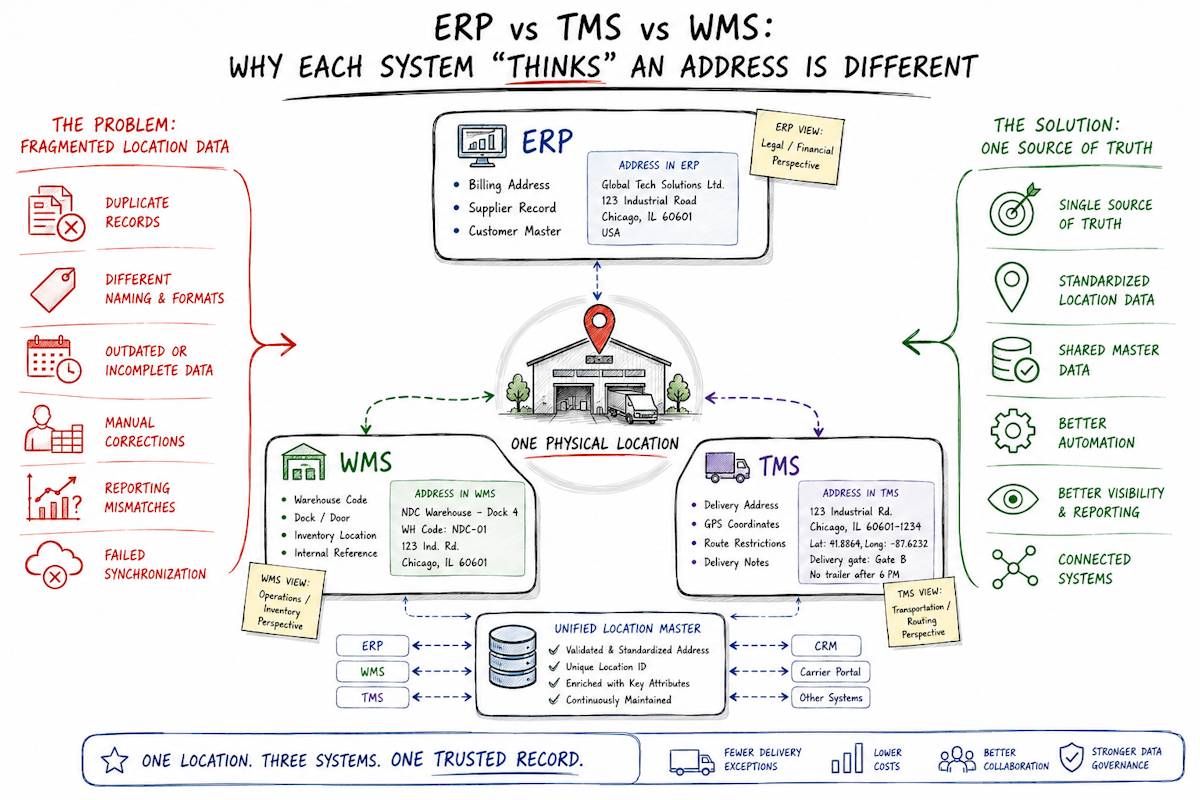
Modern supply chains rely on a growing ecosystem of digital platforms. ERP systems manage customers, suppliers, and financial processes, Warehouse Management Systems (WMS) coordinate inventory and warehouse operations, while Transportation Management Systems (TMS) focus on planning and executing shipments. Add CRM platforms, carrier portals, procurement software, and customer service tools into the mix, and it becomes clear that a single shipment can pass through multiple systems before it reaches its destination.
The challenge is that each of these systems stores and manages location data in its own way. Over time, the same warehouse, supplier, customer, or distribution center can exist in several different versions across the organization. While each record may appear correct within its own application, they often differ in formatting, naming conventions, identifiers, or the amount of information they contain. As a result, every system begins to "think" it is referring to a different location.
This disconnect is one of the biggest yet least visible causes of inefficiencies in modern logistics. In this blog post, we'll explore why ERP, WMS, and TMS platforms frequently maintain different versions of the same address, how this impacts supply chain operations, and why businesses need a more unified approach to managing location data.
Different Systems, Different Priorities
The reason location data becomes fragmented isn't because business systems are poorly designed. On the contrary, each platform is built to support a specific operational purpose.
An ERP system is primarily concerned with customer, supplier, and financial records. A WMS needs detailed information to support warehouse activities such as receiving goods, inventory movements, and outbound shipments. A TMS, meanwhile, requires accurate delivery locations, route planning information, and transportation-specific details. Since every system collects and enriches location data according to its own operational needs, the records naturally evolve in different directions over time.
For example, an ERP might store a company's legal or billing address, while the TMS contains the operational delivery address, complete with GPS coordinates and delivery restrictions. The warehouse system may identify the same location by an internal warehouse code or loading dock reference. Individually, these differences make sense. Collectively, however, they create inconsistency across the supply chain.
One Physical Location, Multiple Digital Identities
Imagine a distribution center that serves hundreds of deliveries every week.
In the ERP system, it might be listed as "North Distribution Center." The warehouse management system could identify it as "NDC Warehouse – Dock 4." The transportation system may only store the street address, while the carrier's platform relies on geographic coordinates and the customer relationship management system includes additional contact information.
Although every record refers to the exact same physical location, the systems often fail to recognize that connection. Instead of one trusted location, the business now has several digital identities for the same place.
This becomes even more complicated when manual data entry, acquisitions, legacy systems, or local naming conventions introduce additional variations. Over time, duplicate records multiply, and employees begin spending more time comparing addresses than trusting the systems that contain them.
The Operational Impact of Fragmented Location Data
When systems cannot consistently identify the same location, operational problems quickly begin to appear.
Transportation planners may optimize routes using outdated delivery information, while warehouse teams prepare shipments using different location records. Customer service representatives may see one version of a customer's address, while carriers receive another. Procurement teams may update supplier information in the ERP, but those changes never reach transportation or warehouse systems.
The result is a growing reliance on manual intervention. Employees spend time validating addresses, correcting records, reconciling inconsistencies, and communicating changes between departments. What should be an automated digital process becomes dependent on emails, spreadsheets, and individual knowledge.
As organizations grow, these inefficiencies become increasingly difficult, and expensive, to manage.
Why System Integrations Don't Solve the Problem
Many businesses assume that integrating their ERP, WMS, and TMS platforms will automatically eliminate location inconsistencies. While integrations improve the flow of information between systems, they do not improve the quality of the information itself.
If one system contains duplicate locations, another stores outdated addresses, and a third follows different formatting standards, integration simply transfers those inconsistencies throughout the technology landscape. Poor data moves more efficiently, but it remains poor data.
Without standardized location management, businesses risk synchronizing incorrect information across every connected application, making the problem even harder to identify and resolve.
The Hidden Cost of Multiple Versions of the Truth
When every system maintains its own version of the same address, the consequences extend far beyond data management.
Duplicate records lead to failed deliveries, manual address verification, warehouse delays, inconsistent reporting, and unnecessary transportation costs. Analytics become less reliable because the same location appears multiple times under different names, while automation becomes less effective because systems cannot confidently determine whether two records represent the same destination.
Perhaps the biggest challenge is that different departments begin trusting different systems. Logistics teams rely on the TMS, finance trusts the ERP, warehouse operators follow the WMS, and customer service references the CRM. Instead of working from one shared version of the truth, every department develops confidence in its own data, making collaboration slower and decision-making more complicated.
Moving Beyond Integration to a Single Source of Truth
The solution isn't to replace existing systems or force them to store identical information. Every platform will always require data specific to its operational role.
Instead, organizations need a single, standardized location record that serves as the foundation for every connected system. Each application can continue storing the operational details it needs, but all of them should reference the same validated and continuously maintained core location data.
By matching duplicate records, standardizing address formats, validating location information, and synchronizing updates across systems, businesses create a single source of truth that improves consistency without sacrificing flexibility. Rather than constantly correcting data issues, teams can focus on improving operational performance.
Why Businesses Must Address This Now
As supply chains become increasingly digital, organizations continue adding new systems, new partners, and new data sources. Without a strategy for managing location data consistently, fragmentation only grows over time.
Emerging technologies such as artificial intelligence, predictive analytics, warehouse automation, and advanced transportation optimization all depend on reliable, standardized location data. Businesses that continue managing disconnected location records will struggle to unlock the full value of these investments, while those that establish a unified data foundation will be better positioned to improve efficiency, visibility, and long-term resilience.
Conclusion
ERP, WMS, and TMS systems don't intentionally disagree about locations—they simply manage them from different operational perspectives. Over time, those independent perspectives create fragmented location data that affects transportation planning, warehouse operations, reporting, customer service, and decision-making across the entire organization.
The answer isn't another system or another integration. It's ensuring that every existing system works from the same trusted location data.
Disclaimer: image created with AI