Customer Experience Breakdown: The "We Couldn't Find Your Address" Problem
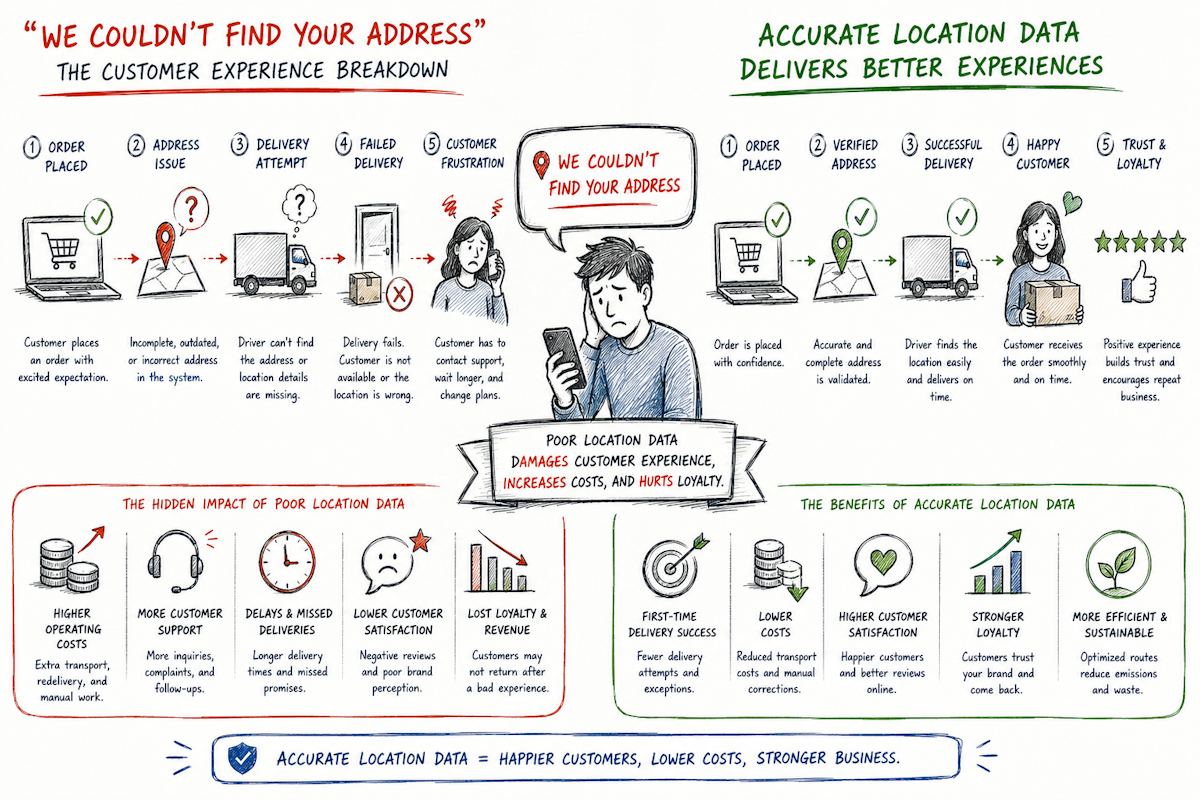
For today's customers, delivery is more than the final step of a purchase, it's a key part of the overall brand experience. Whether ordering consumer goods, industrial equipment, or replacement parts, customers expect deliveries to arrive on time, with accurate tracking and minimal effort.
Businesses have invested heavily in improving the customer experience through faster shipping, real-time notifications, and flexible delivery options. Yet despite these advances, one of the most common delivery failures still begins with a surprisingly simple problem:
"We couldn't find your address."
For customers, this message is frustrating. For businesses, it represents far more than a failed delivery, it signals operational inefficiencies, increased costs, and a loss of customer trust. In many cases, the problem isn't caused by the driver or the carrier at all. It starts much earlier with poor location data.
In this blog post, we will explore how inaccurate location information affects customer experience, why these issues continue to occur, and what businesses can do to prevent them.
The Customer Only Sees the Outcome
Customers rarely think about the complex logistics network working behind every delivery.
They don't see ERP systems, transportation management platforms, warehouse operations, or route optimization software. They simply expect their order to arrive when promised.
When a driver cannot complete a delivery because an address is incomplete, outdated, or inconsistent, customers don't blame the underlying data. They blame the company they purchased from.
From the customer's perspective, the experience is simple:
- The delivery is delayed.
- The tracking stops updating.
- The driver cannot locate the destination.
- A delivery attempt fails.
- Customer support becomes involved.
What customers remember isn't the technical reason for the failure—they remember the inconvenience.
Small Data Errors Become Big Customer Frustrations
Many delivery issues originate from surprisingly small location data problems.
Examples include:
- Missing apartment or suite numbers
- Incorrect building entrances
- Outdated business addresses
- Incomplete industrial site information
- Incorrect postal codes
- Missing gate or loading dock instructions
- Duplicate customer records
- Inconsistent address formatting across systems
To an internal team, these may appear to be minor data quality issues.
To a customer waiting for an important delivery, they become a frustrating experience that often requires additional phone calls, emails, or rescheduled deliveries.
In today's competitive market, even one poor delivery experience can influence future purchasing decisions.
Failed Deliveries Damage More Than Operations
When deliveries fail, businesses often focus on operational costs such as additional transportation, fuel consumption, or driver time.
However, the customer experience carries its own hidden costs.
A failed delivery can result in:
- Increased customer support requests
- Lower customer satisfaction
- Missed service-level agreements
- Negative online reviews
- Lost repeat business
- Reduced customer loyalty
- Damage to brand reputation
These consequences are much harder to measure than transportation expenses, but they often have a greater long-term impact on business performance.
Customers rarely remember the thousands of deliveries that arrived successfully. They remember the one that didn't.
Customer Service Shouldn't Have to Fix Data Problems
When location data is inaccurate, customer service teams often become the last line of defense.
Representatives spend valuable time confirming addresses, contacting carriers, arranging new delivery appointments, and reassuring frustrated customers.
While these efforts help resolve individual issues, they do not address the underlying cause.
Instead of improving customer relationships, customer service teams become occupied with correcting preventable operational problems.
The result is higher support costs, longer response times, and reduced productivity.
Most importantly, customers are forced to invest their own time fixing mistakes that should never have occurred.
The Last Mile Is Where Trust Is Built or Lost
The final delivery is often the only physical interaction customers have with a business.
Marketing campaigns, online ordering platforms, and excellent products all contribute to the customer journey, but the delivery experience ultimately shapes the customer's lasting impression.
When deliveries are reliable, businesses strengthen customer confidence.
When customers repeatedly hear, "We couldn't find your address," trust quickly begins to erode.
Even if the issue is resolved through a second delivery attempt, the original experience has already affected the customer's perception of the brand.
In many industries, reliability has become just as important as price.
Better Customer Experiences Begin With Better Location Data
Improving customer satisfaction is often associated with faster delivery services or better communication.
While these initiatives are important, they are only effective when built on accurate location data.
Organizations should focus on:
- Validating customer addresses before orders are processed
- Standardizing location records across all business systems
- Enriching addresses with delivery-specific information
- Eliminating duplicate customer locations
- Maintaining consistent location data across ERP, WMS, TMS, CRM, and carrier platforms
- Continuously monitoring and updating location information
By improving the quality of location data before a shipment is dispatched, businesses reduce delivery exceptions and create a more reliable customer experience from the very beginning.
Why Businesses Should Act Now
Customer expectations continue to increase.
Consumers and business customers alike expect accurate delivery estimates, real-time visibility, and first-attempt delivery success. At the same time, organizations are competing not only on product quality but also on the reliability of their logistics operations.
Businesses that continue to operate with inconsistent location data will face increasing customer service costs, lower satisfaction scores, and greater pressure on operational teams.
Those that invest in high-quality location data will improve delivery performance, strengthen customer trust, and create a meaningful competitive advantage.
In an environment where customer experience can determine long-term loyalty, accurate location data has become far more than an operational requirement, it has become a business differentiator.
Conclusion
The message "We couldn't find your address" may appear to describe a delivery problem, but it often reflects a much deeper issue.
Poor location data affects every stage of the customer journey, from order processing and transportation planning to final delivery and post-purchase support. What begins as a small data inconsistency can quickly become a negative customer experience that damages trust and increases operational costs.
Organizations that prioritize accurate, standardized, and continuously maintained location data can reduce delivery failures, improve first-attempt delivery success, and create the reliable customer experience that today's market expects.