The Hidden Cost of Duplicate or Incorrect Addresses in Logistics Networks
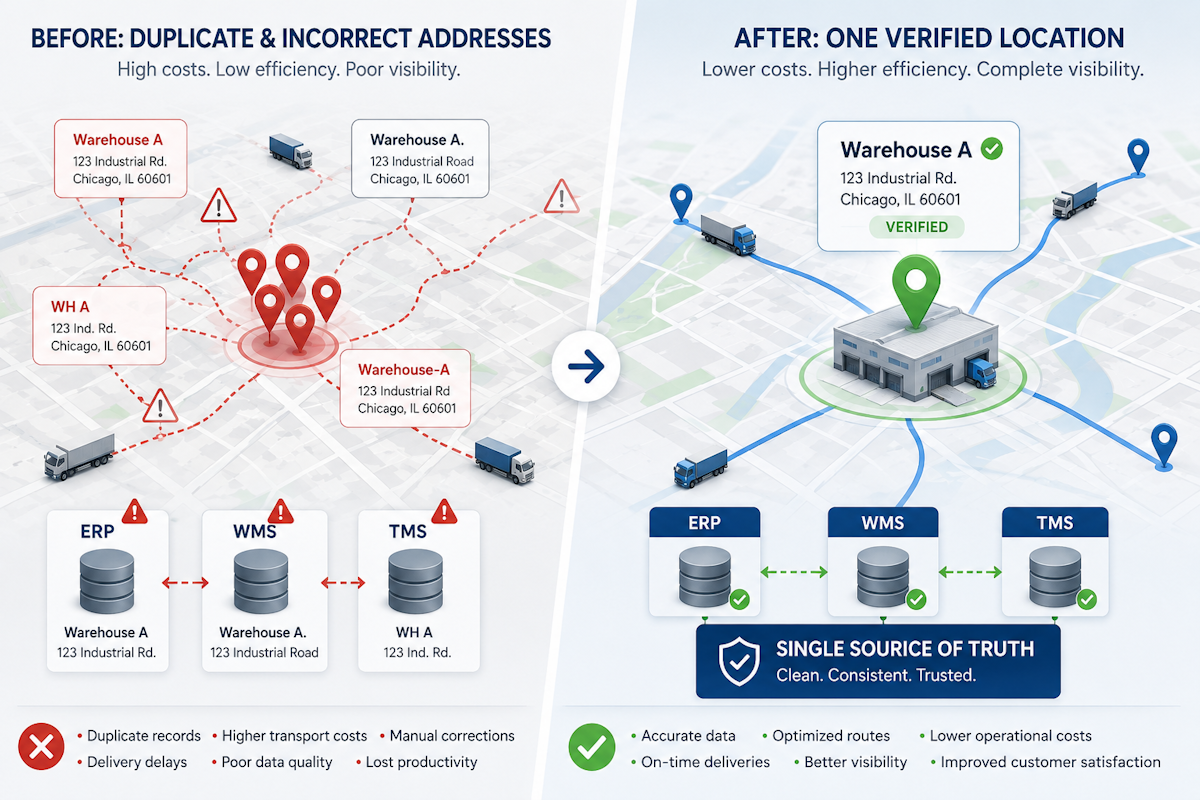
Modern logistics networks depend on one fundamental principle: every location should represent a single, accurate version of the truth. Whether it is a supplier, warehouse, distribution center, retail store, or customer, businesses rely on location data to plan transportation, manage inventory, coordinate deliveries, and analyze supply chain performance.
In reality, however, many organizations operate with thousands of duplicate, outdated, or inconsistent location records spread across multiple systems. The same physical location may exist several times under different names, address formats, or identifiers, making it difficult for systems to recognize that they refer to the same place.
Unlike obvious operational disruptions, duplicate and incorrect addresses often remain unnoticed for months or even years. Yet they quietly increase costs, reduce efficiency, and undermine decision-making across the entire logistics network.
In this blog post, we will explore the hidden costs of duplicate and incorrect addresses, why they are so difficult to identify, and why businesses should treat location data as a strategic asset rather than simply another database field.
How Duplicate Addresses Are Created
Duplicate location records rarely appear because of a single mistake.
Instead, they develop gradually as businesses grow, acquire new customers, expand into new regions, or implement additional software systems.
For example, a customer may exist in an ERP system under one address format, while the same location is entered differently in a transportation management system. Another version may be created when a warehouse team manually enters the destination into a warehouse management system. Over time, each system develops its own version of the same location.
Common causes of duplicate records include:
- Different address formatting conventions
- Manual data entry
- Multiple languages or local naming standards
- Company mergers and acquisitions
- Independent system integrations
- Outdated customer or supplier information
- Lack of centralized data governance
Although each record may appear correct on its own, together they create confusion throughout the supply chain.
When One Location Becomes Many
A duplicate address is more than just an extra record in a database.
When systems treat the same location as multiple destinations, operational decisions become increasingly difficult.
For example, transportation management systems may calculate separate delivery routes for what is actually one customer location. Warehouse systems may maintain duplicate shipping records. Reporting platforms may count the same facility multiple times, producing inaccurate analytics.
As duplicate records multiply, organizations lose confidence in the accuracy of their operational data.
Instead of maintaining one trusted version of each location, businesses begin managing several conflicting versions of the same information.
This creates unnecessary complexity that affects every stage of the supply chain.
The Financial Impact Often Goes Unnoticed
Unlike a failed delivery or a delayed shipment, duplicate location records rarely generate immediate operational alarms.
Instead, they create small inefficiencies that accumulate over time.
Businesses may experience:
- Higher transportation costs
- Duplicate deliveries
- Increased fuel consumption
- Additional warehouse handling
- Manual address verification
- Increased customer service activity
- Inefficient route planning
- Inaccurate reporting
- Lost productivity
Individually, these costs may appear insignificant.
Across thousands of shipments and hundreds of locations, however, they can represent a substantial financial burden.
Because these expenses are spread across multiple departments, organizations often underestimate their true impact.
Incorrect Addresses Create More Than Delivery Problems
While duplicate records create unnecessary complexity, incorrect addresses introduce another layer of operational risk.
A single outdated supplier location may delay inbound shipments. An incorrect warehouse address may affect inventory movements. Missing delivery instructions may increase last-mile delivery times.
These issues often trigger manual intervention across multiple teams.
Transportation planners adjust routes. Warehouse staff verify shipment details. Customer service representatives contact customers for clarification. Carriers spend additional time locating delivery destinations.
The result is a supply chain that relies more on manual problem-solving than on efficient execution.
What begins as a data quality issue quickly becomes an operational challenge.
Poor Data Reduces Visibility Across the Network
Modern supply chains depend on accurate data to support planning, forecasting, and continuous improvement.
However, duplicate and incorrect addresses reduce the reliability of operational insights.
For example, businesses may struggle to answer important questions such as:
- Which customers generate the highest delivery volumes?
- Which suppliers experience the most transportation delays?
- Where should new warehouses be located?
- Which delivery routes require optimization?
- Which regions generate the highest logistics costs?
If multiple records represent the same physical location, reporting becomes fragmented and decision-making becomes less reliable.
Without trusted location data, businesses cannot build a complete picture of their logistics network.
Technology Alone Cannot Eliminate Duplicate Records
Many organizations believe that implementing a new ERP, WMS, or TMS platform will automatically solve duplicate address problems.
Unfortunately, new systems often inherit existing data issues.
If inaccurate or duplicate records are migrated into modern platforms, businesses simply continue managing the same problems using newer technology.
In some cases, system integrations can even accelerate the spread of duplicate data by synchronizing inconsistent records across multiple applications.
This is why technology investments alone rarely solve location data challenges.
Effective location data management requires ongoing validation, standardization, matching, and governance.
Building a Single Source of Truth
Leading organizations increasingly recognize that location data should be managed as a shared business asset rather than as separate records owned by individual systems.
Creating a single source of truth involves:
- Identifying duplicate location records
- Standardizing address formats
- Validating location information
- Matching records across multiple systems
- Maintaining consistent updates throughout the supply chain
- Establishing clear data governance processes
By creating one trusted version of every location, businesses reduce operational complexity while improving efficiency, reporting accuracy, and customer service.
Instead of constantly correcting data issues, organizations can focus on optimizing their logistics operations.
Why Businesses Should Address the Problem Now
Supply chains continue to grow in size, complexity, and digital connectivity.
As organizations expand their logistics networks and adopt technologies such as artificial intelligence, predictive analytics, and warehouse automation, the importance of accurate location data becomes even greater.
Businesses that continue operating with duplicate or incorrect addresses will face increasing operational costs, reduced visibility, and lower technology performance.
Those that establish reliable location data today will build stronger foundations for future growth and digital transformation.
The cost of poor location data is no longer measured only in failed deliveries—it is measured in lost efficiency across the entire supply chain.
Conclusion
Duplicate and incorrect addresses may seem like small administrative issues, but their impact extends throughout every part of a logistics network.
From transportation planning and warehouse operations to reporting, customer service, and strategic decision-making, inconsistent location data quietly increases costs while reducing operational performance.
By treating location data as a strategic business asset and establishing a single, accurate source of truth, organizations can eliminate unnecessary complexity, improve efficiency, and build more resilient supply chains.